
Blog · 3 March 2026
What’s New in HaloITSM: Q4 2025 Product Updates
Discover the latest HaloITSM Q4 2025 updates, including AI enhancements, portal improvements, reporting upgrades and smarter SLA visibility.
BDQ Team
Migration
ITSM
Automation
Customer stories across migration, ITSM, work management and automation.
All success stories →Blog · 3 March 2026
Discover the latest HaloITSM Q4 2025 updates, including AI enhancements, portal improvements, reporting upgrades and smarter SLA visibility.
BDQ Team
HaloITSM continues to evolve as a powerful, flexible IT Service Management (ITSM) and Enterprise Service Management (ESM) platform. The Q4 2025 product updates focus on four key areas: enhanced portal experiences, expanded AI functionality, refined reporting capabilities, and greater administrative control across tickets, dashboards, and configuration.
For organisations investing in modern service delivery, these updates are more than incremental improvements. They represent meaningful steps towards smarter automation, improved visibility, and better user experiences across IT and business service teams.
In this post, we break down the most impactful enhancements from the latest HaloITSM release and explore what they mean for IT leaders, service desk managers, and operational teams.
A well-designed self-service portal is at the heart of any successful ITSM strategy. If end users can’t easily search, submit, or track requests, service teams quickly become overwhelmed.
The Q4 2025 HaloITSM updates introduce improvements that make portal interactions more seamless and intuitive.
Search plays a critical role in deflection and self-service success. Improvements to search functionality allow users to find relevant knowledge articles, services, and tickets more quickly. Better search relevance means:
For organisations scaling ITSM across multiple departments, strong search capabilities are foundational to delivering Enterprise Service Management effectively.
Clear visibility into approvals and Service Level Agreements (SLAs) ensures that requests don’t stall or fall outside agreed timelines.
The latest enhancements improve how SLA information is surfaced, giving both agents and managers greater clarity on:
For service desk managers, this means more proactive management and fewer surprises. For end users, it translates to greater transparency and trust.
Artificial Intelligence is rapidly becoming a standard component of modern ITSM platforms. HaloITSM’s Q4 2025 release expands its AI-driven capabilities, strengthening its position as an intelligent service management solution.
AI in ITSM is no longer just about chatbots. It includes:
These enhancements help reduce manual effort and improve consistency across service teams.
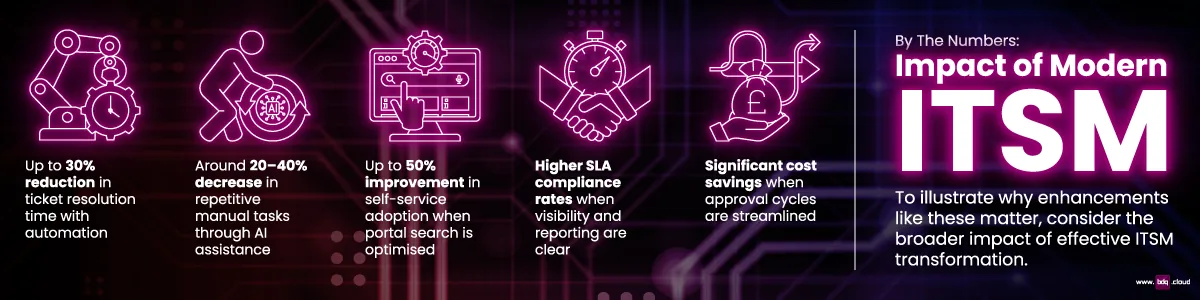
According to industry research, organisations that adopt intelligent automation within IT service management can:
AI-driven features allow service desks to move from reactive firefighting to proactive service optimisation.
By embedding more intelligent capabilities into ticket handling and search, HaloITSM enables teams to focus on high-value work rather than repetitive tasks.
Strong reporting is essential for demonstrating the value of ITSM investments. Service leaders need meaningful KPIs and operational insights - not just raw ticket data.
The Q4 2025 updates refine reporting outputs and dashboard functionality, giving organisations better control over how data is presented and shared.
Enhanced reporting flexibility supports:
For organisations running both ITSM and ESM environments, unified reporting ensures that performance metrics remain consistent across departments.
Effective ITSM reporting typically focuses on measurable outcomes such as:
When reporting is refined and easy to interpret, leadership teams can make informed decisions about staffing, process improvements, and automation priorities.
One of HaloITSM’s strengths is its flexibility. The latest release enhances configuration control across tickets, dashboards, workflows, and system settings.
This means administrators can:
For growing organisations, scalability is key. As service management matures, systems must adapt to evolving requirements. The Q4 updates reinforce HaloITSM’s ability to support both straightforward implementations and more complex enterprise use cases.
Let’s break down the practical implications of these enhancements.
These improvements contribute to a more mature, data-driven service management environment.
Modern organisations expect service management platforms to do more than log tickets. They must:
HaloITSM’s continued investment in usability, AI, reporting, and configuration control reflects these broader industry trends.
As organisations shift from traditional ITSM to Enterprise Service Management, tools must support HR, Facilities, Finance, and other service functions alongside IT. Enhancements to portals, dashboards, and SLA visibility directly support that cross-departmental expansion.
To illustrate why enhancements like these matter, consider the broader impact of effective ITSM transformation:
These are the types of gains organisations aim for when refining their ITSM and ESM platforms.
The Q4 2025 HaloITSM updates support these goals by improving usability, automation, and insight - all essential components of modern service management maturity.
While product updates deliver powerful capabilities, real value comes from effective implementation and configuration.
To maximise the benefits of HaloITSM’s new features, organisations should:
Regular system health checks and configuration reviews ensure that new capabilities are not just enabled - but fully adopted.

IT Service Management is not a one-time project. It is an ongoing journey of optimisation.
Quarterly product updates like those in HaloITSM Q4 2025 demonstrate the importance of:
Organisations that treat ITSM as a living system - rather than a static implementation - consistently outperform those that do not.
HaloITSM’s Q4 2025 updates strengthen the platform’s flexibility, intelligence, and reporting power. From improved portal search and enhanced SLA visibility to expanded AI functionality and refined dashboards, these enhancements support smarter, more scalable service delivery.
If you’re using HaloITSM and unsure whether you’re fully leveraging its latest capabilities - or if you’re considering implementing or optimising your ITSM or ESM environment - now is the ideal time to review your setup.
If anything in this post resonates with your organisation’s goals or challenges, get in touch with BDQ. We’ll help you assess your current HaloITSM configuration and ensure you’re maximising its full potential for modern service delivery.
Book a 30-min consult
Tell us roughly what you’re facing. We’ll come back within one business day with thoughts, references, and a sense of whether we’re a good fit.
Keep reading
Help desk vendor lock-in can make switching feel risky. Learn what creates lock-in and how to plan a smoother ITSM migra
Read article →Learn why context is essential for AI agents, how it improves accuracy and efficiency, and why context beats bigger prom
Read article →Explore common ITSM and work management challenges through WorkFlowFest, a fun festival-inspired take on modern operatio
Read article →We use cookies to keep the site working and to power features like our live chat. Analytics are cookieless. See our privacy policy.