


6 min read
For many years, organisations selected IT Service Management (ITSM) platforms by comparing feature lists.
Today, the conversation is changing.
Choosing an ITSM platform is about more than features
As organisations review software costs, simplify technology estates and modernise service delivery, they're increasingly asking broader questions:
- How easy is the platform to own?
- Can internal teams manage it without extensive development?
- Is the licensing predictable?
- Will it continue to support the organisation five or ten years from now?
These questions are becoming just as important as workflow automation, self-service portals or reporting dashboards.
That shift in thinking is one reason HaloITSM has attracted significant attention across the service management community.
A product built for the long game
In a recent episode of the Service Notes podcast, HaloITSM Founder and CEO Paul Hamilton discussed the philosophy behind the company.
Rather than focusing on rapid expansion or chasing technology trends, he described building a business around:
- customer experience
- continuous learning
- long-term thinking
- product-led growth
One quote particularly stands out:
"Don't seek short-term gratification. Think longer term."
That mindset resonates with organisations making strategic IT investments.
A service management platform isn't simply another software purchase - it's often the operational backbone that supports IT, HR, Facilities, Finance and many other business services for years to come.
Practical AI instead of AI hype
Artificial Intelligence has become a headline feature across enterprise software.
One of the more refreshing aspects of Paul's discussion was his pragmatic view that AI should be seen as one capability within a wider workflow platform - not the entire product proposition.
For organisations evaluating ITSM solutions, this is an important distinction.
Successful service management still depends on:
- well-designed processes
- effective automation
- quality knowledge management
- reporting
- governance
- user adoption
AI can enhance these capabilities, but it cannot replace them.
Why implementation matters just as much as the platform
Selecting the right platform is only part of a successful ITSM transformation.
Implementation determines whether organisations achieve:
- rapid user adoption
- improved reporting
- simplified administration
- scalable governance
- measurable business outcomes
At BDQ, our implementation approach combines consultancy, prototyping, configuration, training and ongoing optimisation to ensure customers gain lasting value from their investment. Our Agile-based Accelerated Implementation Methodology (AIM) focuses on discovery, collaborative design, iterative delivery and continuous improvement.

CHC Helicopter: modernising enterprise service management
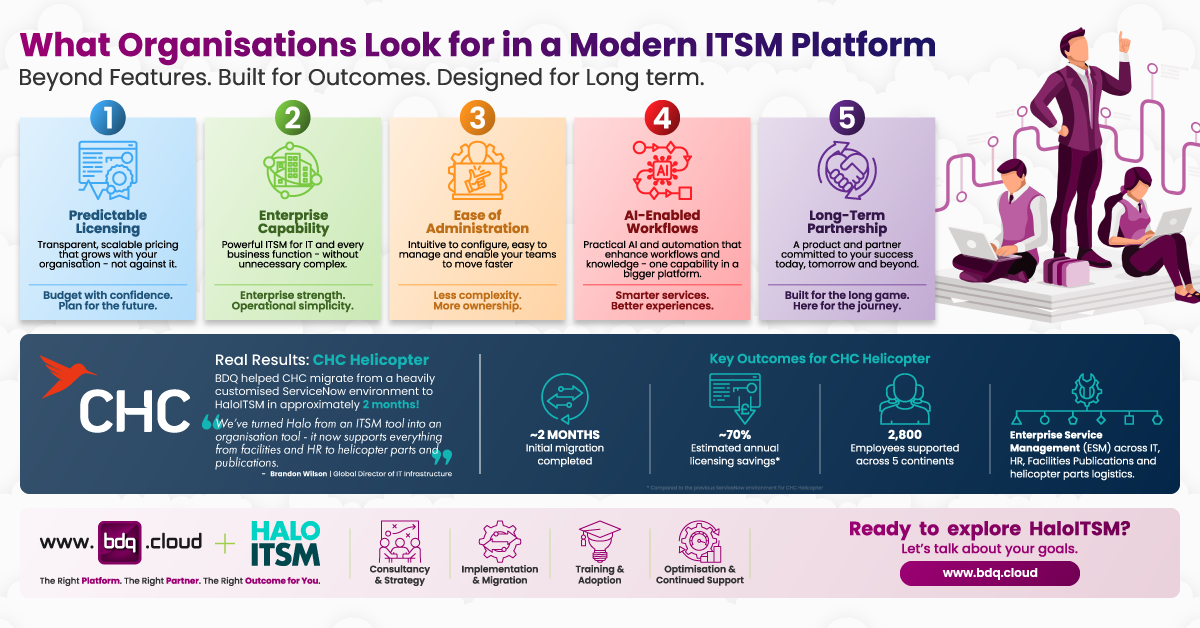
A recent example is CHC Helicopter, a global aviation company operating across five continents with approximately 2,800 employees and highly regulated operations.
After more than 15 years using ServiceNow, CHC wanted to evaluate whether another platform could meet its enterprise requirements while offering a more predictable licensing model.
As Brandon Wilson, Global Director of IT Infrastructure, explained:
"ServiceNow is a very capable product - but did we need all of its features?"
Working alongside CHC's IT leadership, BDQ delivered a phased migration to HaloITSM.
The project included:
- migration from a heavily customised ServiceNow environment
- enterprise service management across multiple business functions
- regulatory and compliance requirements
- collaborative delivery using Jira, Confluence and Microsoft Teams
- user acceptance testing and phased rollout
Despite the scale and complexity, the initial migration was completed in approximately two months.
Real outcomes, not just software
The project wasn't simply about replacing one ITSM tool with another.
It established a modern enterprise service management platform supporting IT and wider business operations.
Today, HaloITSM supports functions including:
- IT
- HR
- Facilities
- Publications
- Helicopter parts logistics
As Brandon Wilson commented:
"We've turned Halo from an ITSM tool into an organisational tool - it now supports everything from facilities and HR to helicopter parts and publications."
CHC also estimated approximately 70% annual licensing savings compared with its previous environment, while retaining the enterprise capabilities required for a global organisation. These figures relate specifically to CHC's environment and should not be considered representative of every organisation.
Why organisations are re-evaluating legacy ITSM platforms
Every organisation's requirements are different.
Some will continue to gain excellent value from existing enterprise platforms.
Others are asking whether they can achieve the same business outcomes with:
- simpler administration
- more predictable licensing
- faster implementation
- greater internal ownership
- reduced operational complexity
Those questions deserve careful evaluation rather than assumptions based on market share alone.
The goal isn't simply to replace software.
It's to build a service management capability that can evolve alongside the organisation for years to come.
Partnering for long-term success
Technology alone doesn't deliver successful transformation.
People, processes and implementation expertise remain critical.
Whether you're introducing HaloITSM for the first time or considering a migration from another service management platform, working with an experienced implementation partner can significantly reduce project risk while accelerating value.
As Brandon Wilson reflected after the CHC project:
"It's been a great journey with y'all... Really, really, really, really happy with the experience."
If you are currently evaluating HaloITSM as a potential solution for your organization's IT service management needs, talk to BDQ to discuss your specific goals, migration plans, or implementation requirements in detail. Engaging with BDQ will help ensure that your evaluation process is aligned with your business objectives and that any transition to HaloITSM is smooth and well-planned.

 Useful Links:
Related Posts
HaloITSM MCP: AI Automation for the Modern Service Desk
Artificial intelligence is quickly becoming a key capability in modern IT Service Management (ITSM)...
How Halo’s Milestones Program is Changing Pricing for ITSM Customers
In an era where software subscription costs are rising and pricing models are increasingly opaque,...
The Rise of the 'Ghost Shift' and What IT Teams Can Do About It
For many organisations, the traditional 9-to-5 working day is no longer the norm.
Whether it's...