

Blog · 5 March 2026
Asana’s AI Growth: What It Means for Modern Work Management
Discover how Asana’s AI expansion and growth signal the future of work management and how organisations can improve collaboration and productivity.
BDQ Team
Migration
ITSM
Automation
Customer stories across migration, ITSM, work management and automation.
All success stories →Blog · 5 March 2026
Discover how Asana’s AI expansion and growth signal the future of work management and how organisations can improve collaboration and productivity.
BDQ Team
The way organisations manage work is evolving rapidly. As distributed teams, increasing workloads, and complex projects become the norm, businesses need smarter ways to coordinate tasks, collaborate across departments, and track progress in real time.
This shift toward modern work management platforms has been accelerating for years, and the latest developments from Asana highlight just how significant that transformation has become.
Asana recently announced strong financial results, continued product innovation, and expanded investments in artificial intelligence (AI). These developments reinforce a broader trend: organisations are increasingly adopting AI-powered work management tools to improve productivity, streamline collaboration, and gain better visibility into their operations.
In this article, we’ll explore what these developments mean for organisations, how AI is changing work management, and why platforms like Asana are becoming central to modern digital transformation strategies.
Work management tools have evolved far beyond simple task tracking systems.
Today’s organisations require platforms that can:
Modern work management platforms such as Asana address these challenges by creating a centralised environment where teams can plan, execute, and monitor work across the organisation.
Rather than relying on spreadsheets, email threads, or disconnected tools, teams gain a single source of truth for projects, tasks, and goals.
This shift has become increasingly important as organisations pursue digital transformation initiatives and seek greater efficiency from their teams.
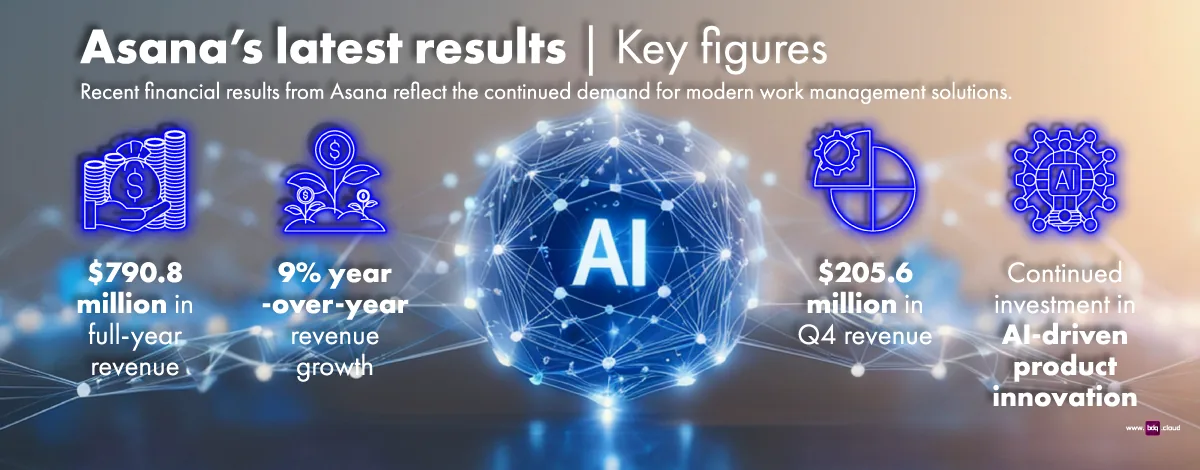
Recent financial results from Asana reflect the continued demand for modern work management solutions.
These numbers illustrate both the company’s growth and the increasing adoption of collaborative work management platforms:
These figures highlight a key trend: organisations are actively investing in tools that help teams coordinate work more effectively and deliver projects faster.
For many companies, productivity gains from better work management can translate directly into improved operational efficiency and cost savings.
One of the most significant developments in Asana’s strategy is the expansion of its AI ecosystem.
Artificial intelligence is increasingly being embedded into work management platforms to help teams:
Asana has expanded its multi-platform AI strategy, including integrations with leading large language models (LLMs). One example is the launch of the Asana app within Claude, enabling teams to interact with their work data through conversational AI.
This shift represents a major step forward in how organisations interact with project data. Instead of manually searching through dashboards or reports, users can potentially ask AI-driven assistants questions such as:
By combining work management data with AI capabilities, organisations gain faster insights and better decision-making support.
At the heart of effective work management is visibility.
Without clear insight into project progress, teams often struggle with:
Work management platforms help address these challenges by making work visible across teams and departments.
For example, organisations implementing Asana often focus on creating structured workflows, reporting dashboards, and collaborative task management systems that allow teams to see what is happening across the organisation.
A real-world example of this approach can be seen in the work BDQ delivered for the Northside Achievement Zone (NAZ). Their organisation relied heavily on spreadsheets and PDFs to track progress against strategic goals, which made reporting manual and time-consuming. By implementing Asana, BDQ helped them create a visible goal structure and dynamic reporting, enabling teams to track progress more effectively and collaborate around shared objectives.
With this new structure in place, NAZ gained improved transparency across its initiatives and could more easily identify bottlenecks and opportunities for improvement.
Organisations across industries use Asana to improve how they manage projects, workflows, and strategic initiatives.
Some of the most common use cases include:
Marketing teams often run multiple campaigns simultaneously. Asana helps centralise campaign planning, content creation, and performance tracking, ensuring everyone stays aligned on priorities and deadlines.
Executives and leadership teams can use Asana to monitor progress toward business objectives, making it easier to identify whether strategic initiatives are on track.
Projects often require input from multiple teams such as marketing, product, operations, and IT. Asana allows these teams to collaborate in one environment rather than switching between multiple tools.
Many organisations automate repetitive processes - such as approvals, task assignments, and status updates - to save time and reduce manual effort.
While modern work management tools are powerful, organisations often achieve the best results when they take a structured approach to implementation.
Successful adoption typically involves:
Working with an experienced consulting partner can help ensure that  organisations maximise the value of their investment.
BDQ, for example, specialises in helping organisations implement and optimise platforms like Asana through a structured engagement approach that includes discovery, planning, prototyping, and training to ensure long-term adoption.
This approach ensures that technology implementations focus not just on the software itself, but on improving the processes and collaboration patterns that drive real business outcomes.
The rapid pace of AI development suggests that work management platforms will continue to evolve quickly over the next few years.
Key trends to watch include:
AI tools may soon help teams automatically generate project plans, timelines, and task structures based on high-level goals.
Advanced analytics could identify project risks earlier by analysing workload, deadlines, and historical data.
Users may increasingly interact with work management systems through conversational interfaces rather than traditional dashboards.
Work management platforms will continue integrating with tools across the enterprise stack, from CRM and ITSM systems to development platforms and analytics tools.
Together, these developments will help organisations move toward more intelligent, automated, and collaborative ways of working.
Asana’s continued growth, expanding AI ecosystem, and increasing adoption highlight a clear trend: modern organisations are investing in smarter ways to manage work.
By combining collaboration tools, real-time reporting, and AI-powered insights, platforms like Asana help teams stay aligned, improve productivity, and deliver better outcomes.
For organisations still relying on spreadsheets, disconnected tools, or manual reporting processes, adopting a modern work management platform can unlock significant improvements in efficiency and visibility.
If any of the challenges discussed in this article sound familiar, BDQ can help you evaluate, implement, or optimise your work management platform. Our consultants work with organisations to design practical solutions that improve collaboration, streamline workflows, and help teams get the most from tools like Asana.
Get in touch with BDQ to discuss how we can help your organisation transform the way work gets done.
Book a 30-min consult
Tell us roughly what you’re facing. We’ll come back within one business day with thoughts, references, and a sense of whether we’re a good fit.
Keep reading
Help desk vendor lock-in can make switching feel risky. Learn what creates lock-in and how to plan a smoother ITSM migra
Read article →Learn why context is essential for AI agents, how it improves accuracy and efficiency, and why context beats bigger prom
Read article →Explore common ITSM and work management challenges through WorkFlowFest, a fun festival-inspired take on modern operatio
Read article →We use cookies to keep the site working and to power features like our live chat. Analytics are cookieless. See our privacy policy.