


7 min read
Artificial intelligence is evolving at an incredible pace. Every few months, a new model, feature or platform promises to help organisations work faster, automate repetitive tasks and unlock new insights.
Yet many businesses quickly discover that while deploying AI is the easy part.
Getting meaningful results is much harder.
That's because AI doesn't automatically understand your organisation. It may know how to write code, summarise documents or draft reports, but it doesn't know your customers, your processes or how your teams actually work.
The organisations seeing the greatest value from AI aren't simply adopting the latest tools. They're giving those tools access to the right information.
Why context matters more than the AI itself
Generative AI has become remarkably capable.
Whether you're using ChatGPT Enterprise, Microsoft Copilot, Google Gemini, Claude or another platform, today's AI assistants can perform impressive tasks in seconds.
But ask them something specific to your organisation and the quality of the answers often drops dramatically.
Questions like:
- Which team owns this project?
- What's our process for onboarding a new customer?
- Where is the latest project documentation?
- Why was this decision made six months ago?
- Which teams are affected if we change this process?
The answers already exist somewhere.
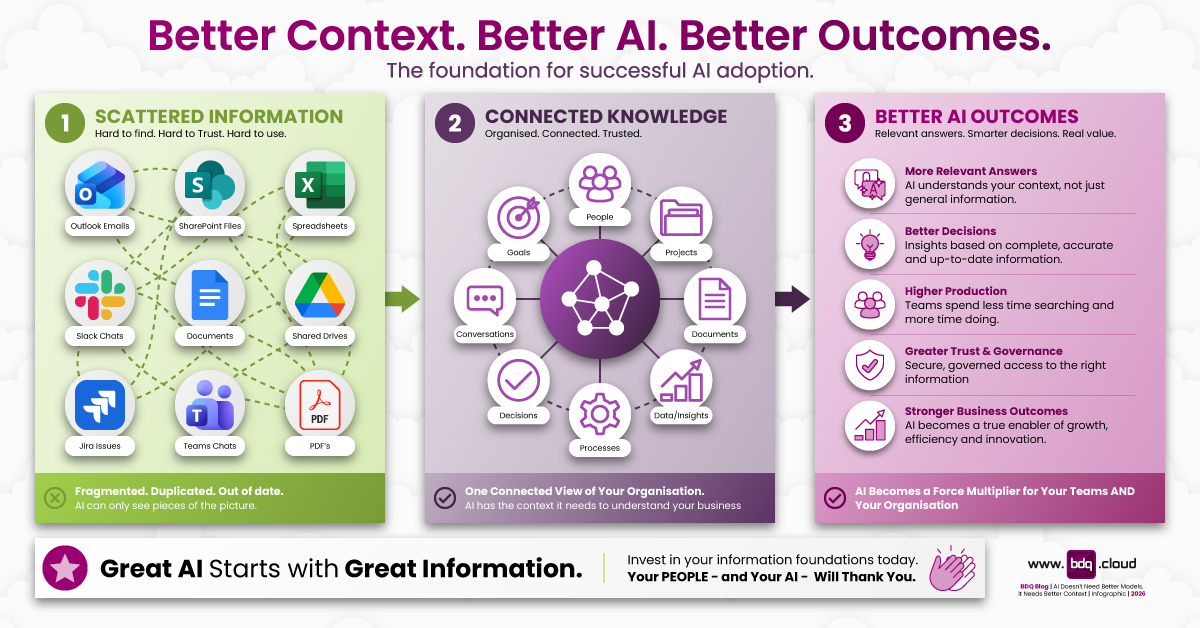
The challenge is that they're usually spread across project management tools, documentation platforms, service desks, shared drives, messaging apps and countless spreadsheets.
AI can only work with the information it's able to access.
The real challenge isn't intelligence - it's knowledge
For years, organisations have invested in systems to manage projects, documents, customer requests and internal processes.
Unfortunately, these systems often evolve independently.
One team stores documentation in one place, another tracks work elsewhere, while important decisions live inside email threads or chat conversations.
Humans are surprisingly good at navigating this complexity because they understand the organisation.
AI isn't.
Without connected information, it has to make assumptions or ask users to provide additional context every time.
This isn't a technology problem as much as an information management problem.
Why this matters now
This challenge isn't unique to any one vendor or AI platform.
Across the technology industry, there's growing recognition that AI needs access to organisational knowledge to deliver meaningful value.
Recently, Atlassian described this challenge as the AI context gap, announcing new capabilities designed to help AI understand relationships between people, projects and knowledge across connected systems.
Similarly, the emerging Model Context Protocol (MCP) aims to provide a standard way for AI assistants to securely access organisational information, regardless of which AI model organisations choose to use.
These developments reflect a much broader industry direction.
The future of AI isn't simply about bigger language models.
It's about better organisational context.

Preparing your organisation for AI
It's tempting to think AI readiness means selecting the right platform.
In reality, most organisations will achieve greater value by first asking questions such as:
- Is our knowledge easy to find?
- Do teams use consistent processes?
- Is information duplicated across different systems?
- Can people trust the data they're working with?
- Are projects, documentation and service management connected?
These questions existed long before generative AI arrived.
AI has simply made them much more important.
Better information benefits people as well as AI
One of the biggest misconceptions about AI is that its benefits begin when you introduce an AI assistant.
In practice, many of the improvements happen much earlier.
Improving documentation makes onboarding easier.
Better project visibility improves collaboration.
Consistent workflows make reporting more reliable.
Connected systems reduce duplicated effort.
These changes improve day-to-day work for people while simultaneously creating higher-quality information that AI can use.
It's a win regardless of which AI platform you eventually adopt.
Building stronger foundations
At BDQ, we've found that successful technology projects rarely begin with software.
They begin by understanding the organisation.
 What outcomes are you trying to achieve?
Where are the bottlenecks?
How do teams collaborate today?
What information does management need to make better decisions?
That's why our engagements focus on discovery, collaborative workshops and rapid prototyping before technology is configured or implemented. Whether we're helping organisations improve work management, implement IT service management, migrate platforms or optimise collaboration, the objective is always the same: create systems that reflect how the business actually operates.
Good information today, better AI tomorrow
Many of the projects we've delivered weren't originally designed with AI in mind, yet they demonstrate why structured information matters.
For example, our work with Universal Robots focused on improving visibility, reporting and collaboration across marketing teams through structured workflows and consistent processes. At NAZ, replacing manual spreadsheets and PDF reporting with shared goals improved collaboration and made organisational knowledge easier to maintain and access. Those projects solved immediate business challenges, while also creating the kind of structured information that modern AI systems can use effectively.
AI readiness is really organisational readiness
Research consistently shows that organisations are enthusiastic about AI but continue to face challenges around data quality, governance and integration when moving from experimentation to enterprise-wide adoption.
The technology itself is advancing rapidly.
The limiting factor is increasingly the quality of organisational information.
That's why AI shouldn't be viewed as a standalone initiative.
It's the next step in a much longer journey of improving collaboration, knowledge management and business processes.
The organisations that gain the greatest advantage won't necessarily be those using the newest AI model.
They'll be the ones with trusted information, connected systems and processes that accurately reflect how their business works.
Those foundations don't just make AI better.
They make organisations better.
 Useful Links:
Related Posts
Atlassian AI Data Contribution Changes: What Customers Need to Know
Atlassian recently announced changes to its AI Data Contribution Settings that will come into...
Why a Product-Agnostic Partner Delivers Better Work Management
When organisations seek to improve their work management systems, the journey often begins with...
Atlassian Rovo: How AI Transforms Team Collaboration
Why Atlassian Rovo is a Game-Changer for Teams and a Reason to Consider Atlassian Cloud.