

Blog · 26 June 2026
Atlassian AI Data Contribution Changes: What Customers Need to Know
Understand Atlassian's new AI Data Contribution Settings and what they mean for Jira, JSM and Confluence customers in regulated sectors.
BDQ Team
Migration
ITSM
Automation
Customer stories across migration, ITSM, work management and automation.
All success stories →Blog · 26 June 2026
Understand Atlassian's new AI Data Contribution Settings and what they mean for Jira, JSM and Confluence customers in regulated sectors.
BDQ Team
Atlassian recently announced changes to its AI Data Contribution Settings that will come into effect from 17 August 2026. The changes have already prompted discussion among Jira, Jira Service Management (JSM), and Confluence customers, particularly those operating in highly regulated industries.
If your organisation works in financial services, government, defence, healthcare, or any other compliance-driven sector, you may be wondering what these changes mean in practice.
In this article, we'll explain what Atlassian has announced, what data may be affected, and the key questions organisations should be asking before the changes take effect.
Atlassian has published details of its new AI Data Contribution Settings, which govern how certain customer data may be used to improve Atlassian products and AI capabilities.
According to Atlassian, contributed data is used to help improve platform functionality, product intelligence, search experiences, and AI-powered features across the Atlassian ecosystem.
For full details, see Atlassian's official announcement visit Atlassian Trust Center: Data practices built for responsible AI.
The changes are scheduled to take effect from 17 August 2026.
Atlassian describes two broad categories of contributed data.
Metadata refers to information about how content and products are used rather than the content itself.
Examples may include:
In-app data refers to the actual content stored within Atlassian applications.
Examples may include:
Atlassian states that contributed data is de-identified and aggregated before being used to improve products and services.
For many organisations, the technical details are only part of the conversation.
The larger question is often governance.
Many regulated organisations have strict policies governing:
Even when data is anonymised, security, legal, procurement, and compliance teams may still need to assess whether the new approach aligns with internal policies and contractual obligations.
As a result, organisations may need to review:
One aspect generating discussion is the distinction between Atlassian licensing tiers.
Many organisations running Jira, Jira Service Management, and Confluence Premium have governance requirements that resemble those of much larger enterprises.
As organisations review the new settings, some may evaluate whether their existing licensing tier provides the level of administrative control they require.
This does not necessarily mean organisations need to upgrade. However, it does mean that administrators, security teams, and platform owners should understand exactly which controls are available within their current environment.
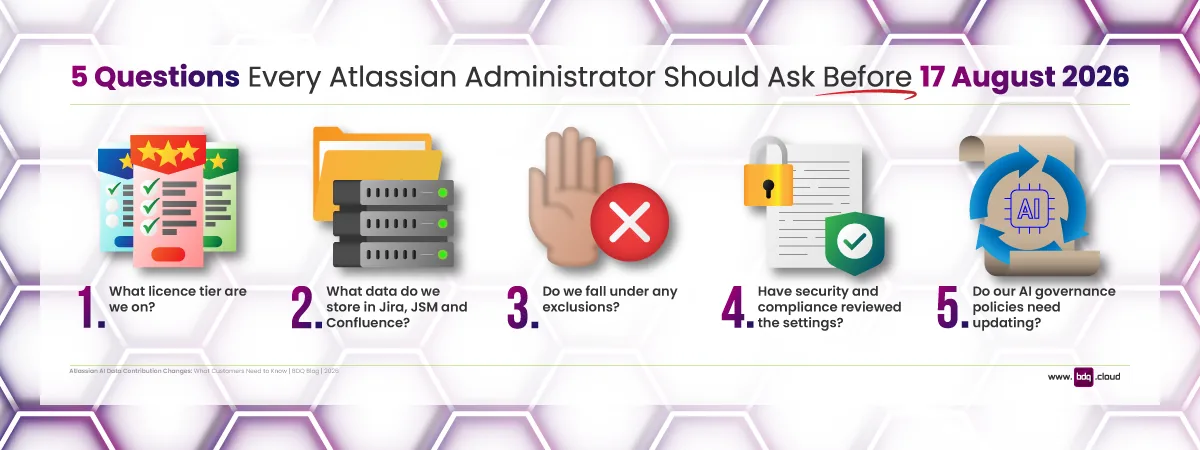
Five Questions Every Atlassian Administrator Should Ask Before 17 August 2026
Rather than reacting to headlines, we recommend taking a structured approach.
Understand:
Where governance requirements exist, involve relevant stakeholders before the changes take effect.
This can help avoid last-minute concerns and ensure decisions are properly documented.
Familiarise yourself with the available settings and how they apply to your organisation's licensing tier.
This may be a good opportunity to review:
Atlassian is not alone in introducing AI-related governance controls.
Across the software industry, vendors are increasingly incorporating AI-powered functionality into their platforms. As a result, organisations are being asked to think more carefully about:
For many organisations, the challenge is not whether AI will become part of the software landscape. It's ensuring that AI adoption aligns with organisational requirements and risk appetite.
At BDQ, we help organisations implement, govern, and optimise Atlassian solutions including Jira, Jira Service Management, and Confluence. We work with customers ranging from SMEs through to enterprise and public sector organisations, helping them establish scalable and compliant ways of working.
If you would like help reviewing your Atlassian environment, governance approach, or administrative configuration, our consultants can assist with:
Questions about Atlassian governance, AI-related controls, or Jira Service Management?
Get in touch with BDQ to discuss your requirements and ensure your Atlassian environment is configured appropriately for your organisation's needs.

→ Atlassian AI Data Contribution Settings
→ BDQ Atlassian Partner Services
→ SaaS Migration & Modernisation
→ BDQ Implementation & Migration Services
Book a 30-min consult
Tell us roughly what you’re facing. We’ll come back within one business day with thoughts, references, and a sense of whether we’re a good fit.
Keep reading
Explore common ITSM and work management challenges through WorkFlowFest, a fun festival-inspired take on modern operatio
Read article →Discover what's new in GLPI Carbon 1.3.0, including total emissions, decommission tracking, and usability improvements f
Read article →Discover why organisations are choosing HaloITSM for long-term service management, and how BDQ helped CHC Helicopter mig
Read article →We use cookies to keep the site working and to power features like our live chat. Analytics are cookieless. See our privacy policy.