


9 min read
For years, businesses have been promised that AI would transform the way people work.
The reality has often been less exciting. Many AI tools require users to leave their existing systems, learn new interfaces, or completely change established processes. As a result, adoption can be slow and the promised productivity gains never fully materialise.
A new generation of AI tools is taking a different approach.
Instead of asking people to work differently, these tools are embedding AI directly into the applications and communication channels teams already use every day.
From Chatbots to Digital Colleagues
One example is Globster.ai, a platform that enables organisations to deploy AI agents into familiar environments such as WhatsApp and Telegram, allowing users to interact with AI without changing the way they work.
What Makes Globster.ai Different?
Globster.ai isn’t just another AI chatbot - it’s designed to function as an intelligent, continuously improving digital assistant within your workflows.
👉 You can explore the platform here:
The significance isn't the technology itself. It's what happens when AI becomes part of everyday operations.
Key capabilities include:
-
Works where you work: Integrates with messaging platforms like WhatsApp and Telegram
-
Context-aware memory: Learns from interactions to improve over time
-
Always-on productivity: Operates 24/7 without interruption
-
1-click deployment: Rapid setup with minimal friction
Why AI Adoption Has Been Difficult
Many organisations are still wrestling with challenges that AI has the potential to address:
- Staff spend too much time chasing updates
- Information is spread across multiple systems
- Repetitive tasks consume valuable working hours
- Teams struggle to maintain visibility across projects
- Important knowledge is locked away in emails, documents, and conversations
The problem isn't usually a lack of technology. It's that technology often creates more places for information to live.
As businesses grow, the amount of communication grows with them. Teams move between project management tools, email, chat platforms, documents, service desks, and spreadsheets simply to find the information they need.
This creates friction that slows down decision-making and reduces productivity.
What Makes AI Agents Different?
Unlike traditional chatbots that answer questions based on a predefined knowledge base, modern AI agents can provide contextual assistance based on previous interactions and ongoing work.
Think of them less as chatbots and more as digital colleagues.
An effective AI agent can:
- Answer routine questions instantly
- Surface information from multiple systems
- Summarise conversations and updates
- Assist with task management
- Help users find documents and knowledge quickly
- Reduce the administrative burden on teams
Most importantly, they are available whenever users need them.
For organisations already embracing digital transformation, this creates opportunities to reduce manual effort and improve responsiveness without increasing headcount.
The Numbers Behind AI-Powered Productivity
The growing interest in AI agents isn't surprising when you look at the wider productivity challenge facing organisations.
Consider the following:

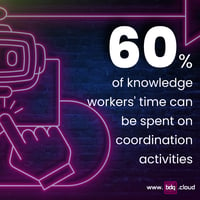
60%
of knowledge workers' time can be spent on coordination activities, including meetings, emails, status updates and information gathering.
30 - 50%
of a team's working week is consumed by administrative tasks, depending on role and industry.

1000+
times per day that employees can switch between applications, creating significant context-switching overhead.

24/7
AI assistance allows organisations to provide support and information outside traditional working hours.
These are the kinds of inefficiencies that AI agents are increasingly being deployed to address.
AI Is Most Powerful When It Works Alongside Your Existing Tools
The most successful AI initiatives rarely start by replacing existing systems.
Instead, they enhance the platforms organisations already rely on.
Whether you're using:
- Monday.com
- Asana
- Jira
- Jira Service Management
- Confluence
- Microsoft 365
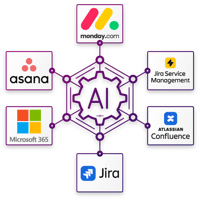
AI agents can act as an additional layer that helps users interact with information more efficiently.
At BDQ, we've seen first-hand how organisations gain value when technology supports existing processes rather than forcing teams to start over.
For example, Universal Robots achieved an estimated 130% improvement in workload efficiency after optimising their work management processes with Asana and BDQ's consultancy expertise.
“We estimate 130% improvement in terms of workload and efficiency vs using spreadsheets, emails and phone calls to coordinate work, which will let us get more done, with less - a significant USD saving.”
- Laura Studwell | Marketing Director (North America), Universal Robots
Similarly, the Northside Achievement Zone (NAZ) moved away from manual spreadsheets and PDF-based reporting to gain improved visibility, collaboration, and dynamic progress tracking.
“It was more efficient, and cost effective to replicate and clone things in Asana, than rework in spreadsheets.”
- Jillian Kahn Burch | Results Manager, NAZ
AI agents represent the next logical step in that journey.
Who Should Be Paying Attention?
AI agents may be particularly relevant if:
- Your teams spend too much time searching for information, which reduces their overall efficiency and slows down project progress.
- Reporting is largely manual, requiring significant effort and time from your staff to compile and analyse data.
- Staff rely heavily on chat applications for communication, which can sometimes lead to fragmented conversations and missed information.
- You want to improve productivity without increasing headcount, aiming to achieve more with the current team by optimising workflows.
- You are already investing in work management or service management platforms, looking for ways to maximise the value of these tools.
- Your employees regularly switch between multiple systems to complete their work, which can cause inefficiencies and disrupt their focus
The organisations seeing the greatest success with AI are often those that already have solid foundations in place for work management and collaboration.
If This Sounds Like You...
You should be exploring AI-enabled work management if:
✅ Teams are overwhelmed by emails, messages, and status requests
✅ Information is difficult to find across multiple systems
✅ Managers lack visibility into ongoing work
✅ Employees spend too much time on repetitive administrative tasks
✅ You're looking for practical AI use cases rather than experimentation
The Bottom Line
The conversation around AI is moving beyond simple chatbots and content generation.
The next wave of innovation is focused on helping people work more effectively within the tools they already use every day.
AI agents won't replace good processes, clear communication, or effective work management. But when combined with the right foundations, they can remove friction, reduce administrative effort, and help teams focus on higher-value work.
If you're exploring how AI could fit into your organisation, now is the ideal time to start evaluating where these technologies can deliver meaningful results.
Not sure where AI agents could deliver value in your organisation?
Book a free AI Readiness Assessment with BDQ.
We'll review your existing work management processes, identify automation opportunities, and help you understand where AI agents can deliver measurable business benefits.

Related Posts
How monday sidekick is Changing Work Management with AI
Meet Your New AI Teammate! - Understanding Monday Sidekick and What It Means for Work Management.
What Monday.com AI Agents Really Mean for Modern Teams
Artificial intelligence is everywhere right now.
What Makes a Work Management Migration Truly Successful
When organisations migrate work management platforms - whether moving from Monday.com to Jira Work...