


7 min read
Artificial intelligence is everywhere right now.
Almost every software platform is announcing new AI capabilities, and work management tools are no exception. It's exciting - but it also creates a challenge.
Many organisations are asking the same question:
"Where do we actually start?"
That question is why a recent social media post from the Monday.com Ambassador Program caught our attention.
Rather than showcasing AI through polished product demonstrations, Monday.com gave its ambassadors early access to AI Agents, allowing real users to experiment with them inside their day-to-day work before general release.
The interesting part wasn't the technology itself.
It was how people chose to use it.
Read Monday.com's recent LinkedIn post about the Ambassador Program here:
AI isn't the strategy - better work is
Whenever a new technology appears, it's tempting to ask:
"What can this tool do?"
A better question might be:
"What problems are we actually trying to solve?"
Looking through the ambassador examples, a common theme begins to emerge.
They weren't trying to build flashy demonstrations of AI.
They were solving everyday frustrations.
Things like:
- Repetitive administration
- Manually updating projects
- Keeping teams informed
- Organising information
- Reducing context switching
- Removing unnecessary manual effort
None of those problems are particularly glamorous.
But they're exactly the kinds of tasks that quietly consume hours every week.
AI works best when it's almost invisible
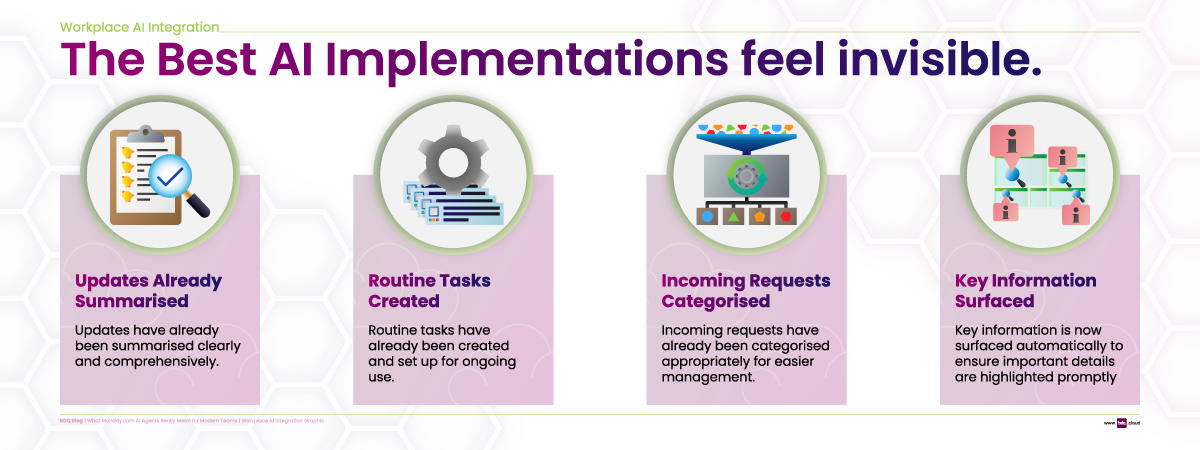
One of the most interesting aspects of workplace AI is that the best implementations often don't feel like "using AI" at all.
Instead, they simply make work feel smoother.
Imagine opening a board and finding:
- Updates already summarised
Updates have already been summarised clearly and comprehensively. - Routine tasks already created
Routine tasks have already been created and set up for ongoing use. - Incoming requests already categorised
Incoming requests have already been categorised appropriately for easier management. - Key information surfaced automatically
Key information is now surfaced automatically to ensure important details are highlighted promptly
Rather than asking people to learn another system, AI becomes part of the workflow they're already using.
That's where adoption becomes much easier.
Why process design matters more than AI
This is something we've seen repeatedly across work management projects.
Technology is rarely the biggest obstacle.
Processes usually are.
Adding AI to a workflow that's already confusing doesn't magically make it better.
In fact, it can simply automate inefficient processes.
Before enabling AI, organisations should ask questions like:
- Which activities genuinely create value?
- Which tasks are repetitive enough to automate?
- Where do projects regularly slow down?
- Which decisions require human judgement?
- How will we know if AI is actually saving time?
Those conversations often uncover opportunities that have nothing to do with AI - and everything to do with improving the way teams work.
The organisations that benefit most won't be the fastest adopters
There's often pressure to "do something with AI."
But speed isn't the same as success.
The organisations likely to see the greatest return are those that:
- experiment in small, manageable ways
- involve the people doing the work
- measure outcomes instead of features
- refine processes as they learn
That's exactly why programmes like Monday.com's Ambassador initiative are valuable.
They create space for experimentation before organisations commit to wider changes.
One phrase from Monday.com 's announcement stood out:
"...experiment with them as new teammates."
That feels like an important shift.
Rather than thinking about AI as another feature, it's becoming something organisations collaborate with.
Like any new teammate, AI works best when:
- Responsibilities are clearly defined
- Expectations are realistic
- People understand where it adds value
- Humans remain responsible for decisions that require judgement
Perhaps that's the most useful mindset organisations can adopt over the next few years.
Not replacing people.
Helping people.
Interested in becoming a Monday.com Ambassador?
If you'd like early access to upcoming Monday.com capabilities and the opportunity to help shape how they're used, the Ambassador Program is worth exploring.
→ Monday.com Ambassador Program
Frequently Asked Questions
What are Monday.com AI Agents?
AI Agents are intelligent assistants built into Monday.com that help automate repetitive work, organise information and support teams within their existing workflows.
Are Monday.com AI Agents available to everyone?
Availability depends on your Monday.com plan and Monday.com 's rollout schedule. New AI capabilities are often introduced gradually before becoming generally available.
Will AI replace project managers?
For most organisations, no. AI is far more effective at reducing administrative work than replacing the communication, judgement and leadership that project managers bring.
What's the best way to introduce AI into work management?
Start small. Identify repetitive tasks that consume time but add little value, automate those first, then build on what works.
Final thoughts
The biggest lesson from Monday.com's Ambassador Program isn't that AI is coming.
Most organisations already know that.
The more interesting lesson is that successful teams aren't waiting for AI to transform the way they work.
They're actively shaping how AI fits into the way they already work.
That shift - from chasing technology to improving outcomes - is where the real opportunity lies.
And that's likely to be the difference between organisations that simply use AI and those that genuinely benefit from it.
Ready to explore AI in Monday.com?
Whether you're evaluating AI Agents or looking to improve your existing workflows, BDQ can help you identify practical opportunities that deliver measurable value.


Related Posts
How monday sidekick is Changing Work Management with AI
Meet Your New AI Teammate! - Understanding Monday Sidekick and What It Means for Work Management.
BDQ are proud to announce that we are official partners of monday.com
We are thrilled to announce that BDQ.cloud has officially become a valued partner of monday.com!
Introducing Monday Service: The Next Evolution in IT Service Management
Monday.com has just launched Monday Service, a powerful new product designed to revolutionize IT...