

Blog · 17 July 2026
Why Software Supply Chain Security Has Never Been More Important
Discover why software supply chain security is critical in the age of AI and open source, and what Sonatype's Gartner recognition means.
BDQ Team
Migration
ITSM
Automation
Customer stories across migration, ITSM, work management and automation.
All success stories →Blog · 17 July 2026
Discover why software supply chain security is critical in the age of AI and open source, and what Sonatype's Gartner recognition means.
BDQ Team
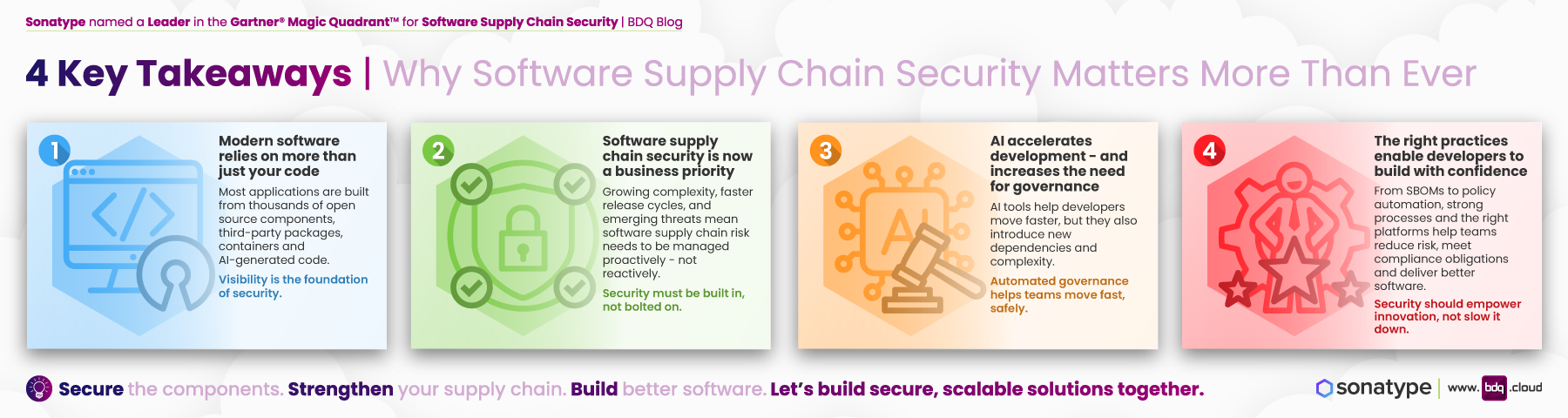
If you've been developing software for any length of time, you've probably noticed that very little is built entirely from scratch anymore.
Software development has fundamentally changed
Today's applications are assembled from thousands of reusable components - open source libraries, container images, third-party packages, APIs and, increasingly, AI-generated code. This has transformed software development, allowing teams to innovate faster than ever before.
The trade-off is that every dependency introduces another potential source of risk.
Whether it's a vulnerable open source library, a compromised package or an outdated dependency, organisations now need visibility across their entire software supply chain - not just the code they write themselves.
Software supply chain security has evolved from a niche security topic into a strategic business concern.
High-profile supply chain attacks over recent years have demonstrated that attackers don't always target organisations directly. Instead, they increasingly target the software components and services those organisations rely on.
At the same time, AI-assisted development is accelerating software delivery. Developers can generate code faster than ever, but that also means organisations need robust processes to ensure the code - and the components it relies on - meet security, quality and compliance standards.
Security is no longer something that happens just before deployment. It needs to be built into every stage of the software development lifecycle.
Against this backdrop, Sonatype recently announced that it has been recognised as a Leader in the Gartner® Magic Quadrant™ for Software Supply Chain Security.
While vendor recognition is always noteworthy, the bigger takeaway is what it says about the wider industry.
Software supply chain security is now recognised as a specialist discipline in its own right, reflecting the growing need for organisations to manage software risk proactively rather than reactively.
 Useful resources
→ Sonatype Gartner Magic Quadrant announcement
→ Learn more about Gartner Magic Quadrants
Modern software is overwhelmingly built using open source software.
According to the 2024 Open Source Security and Risk Analysis (OSSRA) Report, 96% of commercial codebases contain open source software, while 84% contain at least one known open source vulnerability.
Those figures don't suggest open source should be avoided - they demonstrate why organisations need effective governance, visibility and automated security throughout the development lifecycle.
Likewise, Sonatype's own annual State of the Software Supply Chain Report continues to show year-on-year growth in open source consumption, alongside increasing efforts to identify malicious packages before they enter enterprise development environments.
At its heart, software supply chain security helps organisations answer a few fundamental questions:
Modern platforms help answer these questions automatically as developers work, rather than relying on manual reviews at the end of a project.
This enables security teams to focus on governance while allowing developers to continue delivering software at speed.
There's a common misconception that stronger security inevitably creates more friction.
In reality, the opposite is often true.
When developers receive immediate feedback about vulnerable or outdated components, they can fix issues while they're still working on the code. Waiting until the end of the development process almost always makes remediation more expensive and disruptive.
The goal isn't to prevent developers from using open source - it's to help them use it safely and confidently.
Generative AI has changed how many teams develop software.
AI coding assistants can dramatically improve productivity, but they don't remove the need for governance. If anything, they increase it.
As code is generated more quickly, organisations need greater confidence that:
Software supply chain security provides the visibility needed to support these faster development practices without compromising security.
Technology alone is only part of the picture.
Successful software supply chain security also depends on having the right processes, governance and developer adoption.
At BDQ, we help organisations improve the way they deliver software by combining consultancy, implementation and practical guidance with leading technology platforms. Our approach focuses on understanding each customer's goals, rapidly prototyping solutions and ensuring teams can confidently adopt new ways of working.
Whether organisations are modernising their DevSecOps practices, strengthening governance or integrating new development tools, the objective is always the same: help teams deliver software safely, efficiently and with confidence.
Related BDQ resources
→ BDQ Sonatype Solutions
→ Atlassian Consulting & Implementation
→ Contact BDQ
A. Software supply chain security focuses on protecting every component that contributes to an application, including open source libraries, third-party packages, container images and build pipelines.
A. Most modern applications rely heavily on open source software. Understanding which components you're using - and whether they're vulnerable or out of date - is essential for reducing risk.
A. No. It complements traditional application security testing (AST) by focusing on the components that make up an application, rather than only analysing the application's own code.
A. AI can increase developer productivity, but it also accelerates the introduction of new code and dependencies. Organisations need automated governance to ensure these components remain secure and compliant.
A. Not at all. Organisations of every size rely on third-party software components. As development practices become increasingly cloud-native and AI-assisted, visibility into software dependencies is valuable for businesses of all sizes.
Software development isn't slowing down - and neither are the risks associated with modern software supply chains.
Open source software, cloud-native development and AI-assisted coding have fundamentally changed how applications are built. Rather than slowing innovation, organisations need security practices that support rapid development while providing confidence in the software they deliver.
Sonatype's recognition as a Leader in the Gartner® Magic Quadrant™ for Software Supply Chain Security reflects the growing importance of this discipline and the industry's continued focus on helping organisations secure software from the very beginning of the development lifecycle.
As software ecosystems continue to grow in complexity, organisations that invest in visibility, governance and secure development practices will be better placed to innovate with confidence.
Book a 30-min consult
Tell us roughly what you’re facing. We’ll come back within one business day with thoughts, references, and a sense of whether we’re a good fit.
Keep reading
Help desk vendor lock-in can make switching feel risky. Learn what creates lock-in and how to plan a smoother ITSM migra
Read article →Learn why context is essential for AI agents, how it improves accuracy and efficiency, and why context beats bigger prom
Read article →Explore common ITSM and work management challenges through WorkFlowFest, a fun festival-inspired take on modern operatio
Read article →We use cookies to keep the site working and to power features like our live chat. Analytics are cookieless. See our privacy policy.