


6 min read
Many organisations invest in IT Service Management (ITSM) tools to improve support operations, streamline incident management, and provide better services to employees and customers. However, as businesses grow, the service desk systems that once worked well can become inefficient, difficult to report on, or disconnected from other tools.
If your service desk relies heavily on email, spreadsheets, or manual workflows, your ITSM tooling may be slowing your team down rather than enabling them. For IT leaders evaluating service desk improvements, recognising these warning signs is the first step toward modernising IT operations.
In this guide, we explore how to identify when your ITSM platform is limiting performance - and what practical steps you can take to improve your service management processes.
Signs Your ITSM Tool Is Limiting IT Service Management
Many IT teams start with a basic ticketing system or legacy helpdesk tool. Over time, these systems struggle to keep up with growing teams, complex processes, and reporting needs.
Here are some common indicators that your ITSM platform is holding you back:
Limited reporting and visibility
Leadership teams often struggle to answer basic questions such as:
- How many incidents are open?
- Which services are generating the most tickets?
- Where are support bottlenecks occurring?
Without strong reporting dashboards, it becomes difficult to make data-driven decisions about staffing, priorities, and service improvements.
Email-driven service desks
Many organisations still manage requests through shared inboxes or loosely structured ticket systems. This leads to:
- Duplicate requests
- Lack of prioritisation
- Lost communication threads
- Poor audit trails
Modern service desk software provides structured workflows, automated routing, and searchable knowledge bases to eliminate these problems.
All tickets treated as high priority
If every request appears urgent, it often means the system lacks proper categorisation for:
- Incidents
- Service requests
- Problems
- Changes
Without these structures, teams cannot effectively prioritise work or measure service performance.
For organisations adopting ITIL-aligned ITSM practices, structured workflows are essential for maintaining control and visibility. You can learn more about the ITIL framework at www.axelos.com or view BDQ’s specific ITIL solutions here: BDQ ITIL Maturity Model Assessments.
The Business Impact of Modern ITSM Platforms
Modern ITSM platforms such as Atlassian’s Jira Service Management (JSM), Asana, and HaloITSM provide capabilities that dramatically improve service delivery and operational efficiency.
These improvements typically include:
- Structured ITSM workflows for incidents, requests, problems, and changes
- Self-service portals for internal users and customers
- Automation rules to reduce manual ticket handling
- Knowledge bases to deflect repetitive requests
- Dashboards and analytics for leadership visibility
A modern service desk enables organisations to move from reactive support to proactive service management.
For example, platforms like Jira Service Management provide built-in incident and change workflows, a branded self-service portal, and integrated knowledge management to help organisations transition from ad-hoc support to a scalable ITSM solution.
Key statistics IT leaders should consider
These indicators can help highlight whether your current ITSM tooling is limiting operational effectiveness:
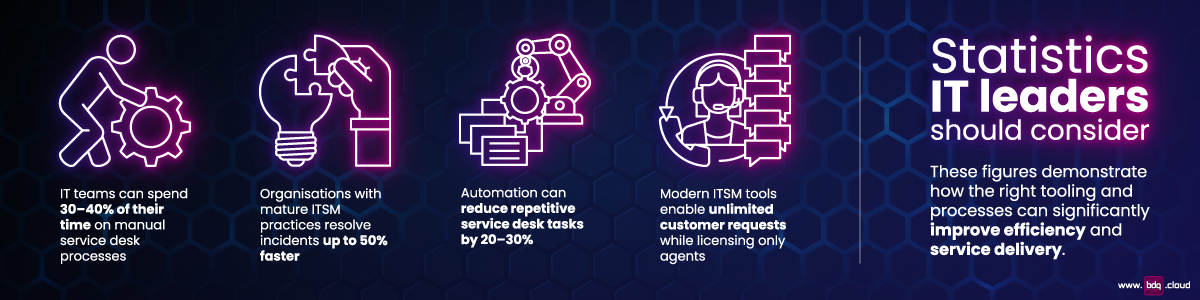
- IT teams can spend 30–40% of their time on manual service desk processes
- Organisations with mature ITSM practices resolve incidents up to 50% faster
- Automation can reduce repetitive service desk tasks by 20–30%
- Modern ITSM tools enable unlimited customer requests while licensing only agents
These figures demonstrate how the right tooling and processes can significantly improve efficiency and service delivery.
Implementation Steps to Modernise Your ITSM Tooling
If you suspect your ITSM platform is limiting efficiency, a structured improvement approach can help modernise your service desk.
Step 1 – Assess your current service desk processes
Start by evaluating how your existing ITSM environment works today.
Questions to ask include:
- Are incidents, requests, and changes clearly categorised?
- Can you easily generate service performance reports?
- Are tickets routed automatically or manually?
An ITSM assessment can quickly highlight process and tooling gaps.
Step 2 – Define your IT service management goals
IT leaders should clarify the outcomes they want from their service desk platform, such as:
- Faster incident resolution
- Improved management reporting
- Reduced manual administration
- Better collaboration between IT teams
Having clear objectives ensures the new system is aligned with business priorities.
Step 3 – Implement a scalable ITSM platform
Modern tools like JSM allow organisations to deploy a minimum viable service desk quickly and expand functionality as processes mature.
Typical features implemented first include:
- Incident management
- Service request workflows
- Self-service portal
- SLAs and automation rules
Additional capabilities such as asset management, onboarding workflows, and integrations can be added later.
Step 4 – Train teams and encourage adoption
Technology alone does not deliver ITSM maturity. Training, documentation, and internal champions help ensure teams adopt the new processes successfully.
Real-World Example: Improving Service Desk Visibility
A practical example of ITSM improvement comes from The Wine Society, which sought to improve visibility and reporting across its IT support operations.
Their legacy service desk provided very limited reporting and made it difficult to distinguish between different types of IT requests. This lack of structure meant leadership could not easily prioritise work or understand team workloads.
By implementing Jira Service Management, the organisation was able to:
- Introduce structured workflows for incidents and requests
- Improve reporting dashboards for leadership visibility
- Enable better collaboration between support and development teams
- Provide a consistent system for users to submit IT requests
The result was significantly improved operational insight and service management efficiency, enabling better decision-making for IT leadership.
Read the Full Case Study >>
Case Studies Home >>
If this sounds like you…
You should consider reviewing your ITSM tooling and service desk strategy if:
- Your service desk relies heavily on email or manual ticket handling
- Reporting from your ITSM system is limited or difficult to generate
- Your team struggles to prioritise incidents and service requests
- Support and development teams work in separate systems
- Your organisation is scaling, and your service desk cannot keep up
In these situations, modernising your IT Service Management platform can significantly improve efficiency, collaboration, and service delivery.
Book a 30-Minute ITSM Strategy Session
If your current ITSM tooling is limiting visibility, automation, or service delivery, it may be time to review your approach.
BDQ helps organisations modernise their IT Service Management environments, including consulting, implementation, migration, and training for platforms such as Jira Service Management.
In a 30-minute ITSM strategy session, we will:
- Review your current service desk setup
- Identify opportunities for improvement
- Recommend practical next steps for modernising your ITSM platform
👉 
If any of the challenges described in this article sound familiar, our team would be happy to discuss how you can build a more scalable and effective service desk.
Related Posts
HaloITSM MCP: AI Automation for the Modern Service Desk
Artificial intelligence is quickly becoming a key capability in modern IT Service Management (ITSM)...
1-Click AI Agents Are Moving Into Your Daily Workflow
For years, businesses have been promised that AI would transform the way people work.
The reality...
Green IT Starts Earlier Than You Think
Many organisations are investing heavily in sustainability initiatives, carbon reporting, and CSR...