

Blog · 26 March 2026
Why Developer Experience Matters Beyond Developers
Learn how developer experience (DevEx) principles can boost enterprise productivity, collaboration, and outcomes across technical and non-technical teams.
BDQ Team
Migration
ITSM
Automation
Customer stories across migration, ITSM, work management and automation.
All success stories →Blog · 26 March 2026
Learn how developer experience (DevEx) principles can boost enterprise productivity, collaboration, and outcomes across technical and non-technical teams.
BDQ Team
Developer experience (DevEx) has traditionally been framed as a concern for engineering leaders: better tooling, clearer workflows, and fewer blockers so developers can write code faster and with less frustration. But as Atlassian outlines in a recent CIO article, developer experience is no longer just a technical concern.
It is a blueprint for enterprise productivity.
At its core, DevEx focuses on intentionally designing how work gets done, not just what work gets done. When organisations apply these principles across the business, they remove systemic friction, improve collaboration, and enable teams to deliver better outcomes - faster and more consistently.
In this post, we’ll explore what developer experience really means, why it applies to every team in the organisation, and how leaders can use DevEx principles to design a more effective system of work. We’ll also look at measurable benefits, common pitfalls, and practical steps for implementation using modern work management and collaboration platforms.
Developer experience refers to the quality of interactions developers have with their tools, processes, teams, and organisational systems. This includes:
While DevEx originated in software engineering, its principles are universal. Any role that relies on systems, workflows, and cross-team collaboration can benefit from the same thinking.
In fact, most employees today are “knowledge workers” operating within complex digital environments. They face similar challenges to developers: fragmented tools, unclear processes, duplicated effort, and constant context switching. When these issues are left unaddressed, productivity suffers across the entire enterprise.
The key insight from Atlassian’s perspective is that developer experience is a proxy for organisational health. If developers - often among the most system-dependent employees - are struggling, it’s likely that other teams are experiencing similar or worse friction.
When organisations expand DevEx thinking to all teams, they begin to focus on:
This shift reframes productivity as a systems problem, not a people problem. Instead of asking, “Why aren’t teams working faster?”, leaders ask, “What is slowing teams down?”
A system of work is the combination of tools, processes, roles, and behaviours that determine how work flows through an organisation. Most enterprises don’t intentionally design this system - it evolves organically over time, often resulting in complexity and inefficiency.
Applying DevEx principles means taking a step back and asking:
By answering these questions, organisations can begin to remove friction points that slow everyone down.
In our consulting work, we often find that organisations already have the right tools in place - but the system of work has never been intentionally designed. Teams are busy, but priorities, ownership, and flow are unclear. Once these fundamentals are mapped and prototyped, productivity improvements tend to follow quickly.
Before improving developer or employee experience, it’s important to recognise the most common barriers that exist in large organisations:
These challenges are not unique to engineering teams - they affect marketing, HR, operations, finance, and IT alike.
A common pattern we see is teams relying on spreadsheets, email, and static documents long after they’ve outgrown them. Reporting becomes manual, visibility is delayed, and leaders lose confidence in the data. This is often the tipping point where organisations start rethinking how work flows across teams.
Developer experience works as a model for enterprise productivity because it focuses on flow. High-performing development teams optimise for:
When applied across the business, these same principles enable teams to move from reactive, ad-hoc work to structured, outcome-driven delivery.
Rather than enforcing rigid processes, DevEx-inspired systems provide flexibility within a consistent framework. Teams retain autonomy, but leadership gains visibility and confidence in execution.
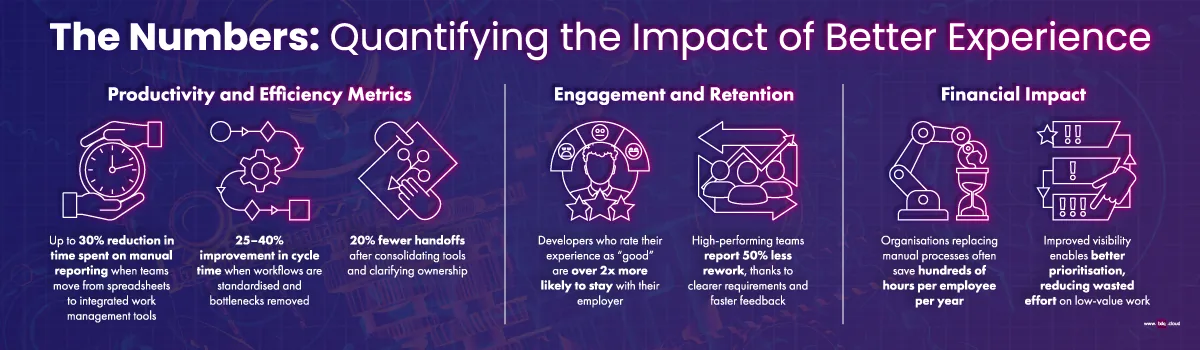
To understand why experience-driven design matters, it helps to look at measurable outcomes. Organisations that invest in improving developer and employee experience consistently report significant gains.
One common misconception is that improving developer experience means buying new tools or offering perks. While tooling matters, DevEx is primarily about how tools are used within a coherent system.
For example, simply rolling out Jira, Confluence, or another platform without redesigning workflows often results in limited adoption and frustration. The value comes from aligning tools with outcomes, processes, and behaviours.
This is why intentional design and enablement are so important. Teams need clarity on:
Without this context, even the best tools fail to deliver value.
So how can organisations extend developer experience thinking beyond engineering?
When organisations apply developer experience principles beyond engineering, adoption improves dramatically. Teams feel supported rather than constrained, and leaders gain meaningful visibility without adding process overhead. The key is balancing autonomy with shared conventions - a design challenge, not a technology one.
Leadership plays a critical role in scaling DevEx principles. Without executive support, improvements often remain isolated within individual teams.
Effective leaders:
By modelling these behaviours, leaders create an environment where teams can thrive.
Modern platforms like Atlassian’s suite are powerful enablers of better developer and employee experience - but only when implemented thoughtfully.
The most successful organisations use technology to:
This is where expert guidance often makes the difference between a tool rollout and a genuine transformation.
Developer experience is ultimately about respecting people’s time, attention, and expertise. When organisations design systems that support how people actually work, productivity becomes a natural outcome rather than a forced metric.
By applying DevEx principles across the enterprise, leaders can create environments where teams collaborate more effectively, deliver value faster, and adapt more easily to change.
If any of the challenges or opportunities discussed in this post resonate with your organisation, we’d love to talk.
Get in touch with BDQ to explore how intentional system design and modern work management can help your teams work better together.
Book a 30-min consult
Tell us roughly what you’re facing. We’ll come back within one business day with thoughts, references, and a sense of whether we’re a good fit.
Keep reading
Explore common ITSM and work management challenges through WorkFlowFest, a fun festival-inspired take on modern operatio
Read article →Discover what's new in GLPI Carbon 1.3.0, including total emissions, decommission tracking, and usability improvements f
Read article →Discover why organisations are choosing HaloITSM for long-term service management, and how BDQ helped CHC Helicopter mig
Read article →We use cookies to keep the site working and to power features like our live chat. Analytics are cookieless. See our privacy policy.