Most organisations already deliver internal services. They onboard new starters, review contracts, raise purchase orders, fix the heating, change someone's system access. What they rarely do is manage those services systematically. The work happens through email, Teams messages, spreadsheets, tribal knowledge, and the occasional phone call — and everyone quietly accepts the chasing, the lost requests, and the unpredictable turnaround as the cost of doing business.
Enterprise Service Management (ESM) is the discipline that fixes that. It takes the service-delivery practices IT has spent years refining — clear service definitions, structured intake, workflow, automation, knowledge, and measurable performance — and applies them across the whole organisation. This guide is platform-agnostic and written for the person who usually ends up owning ESM: the IT director. We cover what ESM actually is, how it differs from ITSM and from work management, where it pays off first, and how to roll it out without it collapsing under its own weight.
We wrote this guide because we have seen what internal service delivery looks like in the real world when it is not managed as a service. We have seen work tracked on spreadsheets that become impossible to maintain. We have seen Facilities run, believe it or not, through WhatsApp groups — intake and work management all happening in the same chat thread. Those approaches can work for a while, but they do not scale, they do not create visibility, and they make it hard to improve anything intentionally.
We have also seen the more typical journey: organisations implement ITSM (often on-premise first), prove the value of structured service management in IT, and then other departments start asking for the same thing — better intake, clearer ownership, fewer interruptions, and a consistent experience for employees. Today that often expands further through cloud migration or platform consolidation, where teams want to extend beyond IT into enterprise-wide service delivery. So if you already have ITSM and you are thinking about ESM — or you have heard the term and want to understand what is genuinely different — this guide is for you.
ESM in plain English
ESM replaces a fragmented approach with a single, predictable one. Instead of guessing who to email, employees go to one "front door", choose the service they need, give the right information, and get clear expectations about what happens next. Behind the scenes, the request routes through a proper workflow — approvals, escalations, ownership — and its progress stays visible to everyone who needs to see it.
That is the whole idea, stripped back: take work that already happens informally and give it structure, visibility, and a feedback loop. ESM is not about adding bureaucracy. It is about professionally managing services the organisation is already providing badly.
Why ESM matters now
The case for ESM has sharpened over the last few years for four practical reasons.
Hybrid work made informal delivery expensive
Remote and hybrid working removed the hallway conversations and desk visits that used to paper over broken processes. Informal workflows are brittle once everyone is distributed. ESM gives you a consistent way to request, track, and fulfil work regardless of location or timezone.
Email became the default work queue — and it is a bad one
When email is the queue, requesters have no visibility and chase constantly; teams cannot prioritise, so everything feels urgent; work stalls when the intake information is incomplete; knowledge stays trapped in individual inboxes; reporting is weak; and the audit trail is unclear, which raises compliance risk. Email is wonderful for conversation and terrible for managing demand.
Employee experience is now a board-level topic
Employees compare internal services to the consumer experiences they have everywhere else. They can track a parcel in real time, then have no idea whether their contract review or onboarding has even been picked up. That gap is increasingly something the board notices.
Cost pressure forces standardisation
Organisations doing more with the same headcount have to cut avoidable back-and-forth, rework, and interruptions. ESM standardises where it helps, while leaving room for the specialist judgement that genuinely needs it.
ESM vs ITSM
ESM borrows heavily from ITSM — service catalogues, SLAs, knowledge, workflow, automation, reporting — but it operates in a different reality. Services are business-focused rather than technical. The language has to be adapted or adoption fails. Data sensitivity is often much higher, particularly in HR and Legal. And governance is usually federated: departments own their services while a central team maintains the platform and standards.
The clearest way to hold the distinction in your head: ITSM professionalised how IT delivers services. ESM professionalises how the organisation delivers services to itself.
The short version If a request is technical and lands in IT, that is ITSM. If a request is a business service delivered by HR, Finance, Facilities, Legal or Procurement, that is ESM. Same underlying discipline, different audience, different language, and usually higher data sensitivity.
A lot of ESM explanations stop at "ITSM, but for other departments". That is directionally true, but it misses the practical differences that matter during rollout. The comparison below is the one IT leaders tend to find most useful.
| Dimension | ITSM | ESM | What changes for you as IT director |
|---|
| Primary focus | IT service delivery and support | Internal services across all functions | You move from IT-only optimisation to enterprise-wide service orchestration |
| Typical demand | Incidents, requests, changes, problems | Requests and cases for HR, Finance, Facilities, Legal, etc. | The "case" model often becomes more important than classic incident/change |
| Language | Technical/service ops language | Business-friendly, function-specific language | You translate service management principles without imposing IT terms |
| Data sensitivity | Moderate (varies) | Often high (HR/legal/finance) | You need stronger access models, segmentation and auditing |
| Governance | Centralised IT governance | Federated: central standards plus local ownership | You will need a cross-functional operating model, not just IT processes |
| Success measures | Availability, MTTR, change success | Cycle time, employee effort, compliance, service quality | The business outcomes become the headline, not the tool metrics |
ESM vs work management and project management
A fair question comes up early: "doesn't our work management tool already do this?" The easiest distinction is repeatable services versus planned delivery. Work management and project tools excel at planned, deadline-driven, deliverable-based work that depends on project structure. Service management handles request-driven, repeatable, high-volume work that needs triage, prioritisation, routing, and consistent outcomes with approvals and auditability.
The "front door plus execution layer" pattern
Sometimes that question is a signal that the organisation is using a project tool to compensate for a lack of service intake and triage. It can work for a while, but it usually breaks down at scale.
In practice the two work best together. The service management layer is the front door: it captures demand, ensures the right information is supplied, routes the request, and keeps the requester informed. The work or project management layer is the execution space: teams plan, deliver, collaborate, and manage dependencies. An office relocation, for example, might start as a structured service request, then trigger coordinated execution across IT, Facilities and Security — sometimes run as a project behind the scenes — while the requester sees one joined-up experience.
Here is the comparison in a way that usually settles the debate quickly.
| Dimension | ESM (service management) | Work / project management |
|---|
| Best for | Ongoing internal services and operational demand | Planned initiatives, projects, cross-team delivery |
| Entry point | Service catalogue / portal / structured request | Project/task creation by teams |
| Prioritisation | Based on impact/urgency and service targets | Based on project deadlines and delivery goals |
| Experience for requesters | "I need X" leads to guided intake and status tracking | Often indirect; requesters may not have a clear view |
| Governance | Service ownership, SLAs, knowledge | Delivery ownership, milestones, dependencies |
| Where it struggles | Deep planning for complex programmes | High-volume requests, triage, and consistent intake |
So if you are aiming for a single front door for internal help and services, ESM is the natural foundation. Work management remains essential, but it is not a substitute for service intake and service performance management.
The service management front door
Without ESM, employees navigate a maze: email HR, message someone on Teams, hunt for the right form, wonder who approves it, and never quite know the status. As we mentioned in the introduction, we have seen Facilities management run from WhatsApp groups, and ITSM from shared mailboxes. We have all seen this sort of thing happen — a quick and dirty system to solve a problem takes root, then becomes part of the way of working, regardless of the inefficiencies it creates.
With ESM, employees go to one place, pick the service they need from a catalogue, and get clear next-step expectations. That front door can support different channels — portal, email-to-ticket, chat intake — but the key is that all demand lands in one trackable system. Three things change when you build a real front door.
Intake becomes structured, so delivery becomes faster
Good service forms ask the right questions, not every question. A contract review might need type, counterparty, value band, deadline and risk factors. A facilities request might need location, urgency, impact and a photo. Structured intake means teams spend less time investigating and more time delivering.
Requests stop being messages and become cases
Messages are easy to send and hard to manage. Cases can be routed, assigned, escalated, measured, audited, and improved. That shift — from message to case — is most of the value.
The organisation gains visibility into demand
Once demand is visible you can make resourcing decisions from data, automate based on real volume patterns, target service improvements at genuine bottlenecks, and have more honest conversations about what "urgent" actually means.
Departments as service providers
The mindset shift underneath ESM is simple: every department that receives requests is a service provider. It has internal customers, repeatable services, and expectations around speed, quality and compliance. This is not about creating bureaucracy — it is about naming what already exists and managing it professionally. Service catalogues do not need to be complex to begin with. Start with one question per team: "What do people ask us for most often, and what information do we need to handle it well?"
To make that real, here is what "department as service provider" looks like in everyday terms.
| Function | Example service | Without ESM | With ESM |
|---|
| HR | Onboarding | Emails, spreadsheets, constant chasing | One onboarding request triggers coordinated fulfilment across teams |
| Facilities | Maintenance request | Phone calls plus mailbox plus unclear urgency | Categorised requests, mobile-friendly intake, clear priorities and SLAs |
| Finance | Purchase approval | Informal approvals, unclear status | Defined approval workflow, audit trail, visibility for requester |
| Legal | Contract review | "Can you look at this today?" chaos | Service tiers, required intake, predictable turnaround and status tracking |
| Procurement | New supplier onboarding | Delays due to missing info | Guided intake, consistent checks, clearer cycle time |
| Security | Access requests | Mixed channels, inconsistent approvals | Policy-driven access workflows and auditability |
ESM is not just a tool change; it is an operating model change. The tool is the visible part, but the value comes from the service thinking behind it.
Where ESM delivers value first
Successful programmes rarely go enterprise-wide on day one. They start where the pain is obvious and the wins are provable.
HR: onboarding and the employee lifecycle
Onboarding naturally crosses boundaries — HR owns it, but it touches IT, Security, Facilities, Finance and sometimes Legal. Run through email and spreadsheets, delays feel inevitable. With ESM, onboarding becomes orchestrated: structured intake, a workflow, and clear ownership for each fulfilment step.
Facilities: high-volume, high-interruption demand
Facilities teams are often overwhelmed by request volume and interrupted by genuine emergencies arriving in the same channel as routine work. ESM separates urgency from noise and gives predictable logging and tracking, including mobile options for distributed workforces.
Legal: visibility and predictability
Legal teams tend to resist "ticketing" until they see the upside: fewer interruptions, better intake quality, more predictable turnaround, and a documented audit trail. A well-designed legal catalogue also reduces avoidable work through templates, guidance and self-service.
Finance and procurement: approvals, compliance and transparency
Finance and procurement requests often disappear into invisible approval loops. ESM makes those workflows visible and measurable, which is usually the first step to improving them.
The building blocks of ESM
Whatever the function, a working ESM capability is built from the same handful of components.
A service catalogue people actually use
A good catalogue helps employees quickly answer "which option matches what I need?" Services need plain-language names, sensible structure and built-in guidance. A catalogue also gently shapes demand by nudging people towards the right request type and capturing the right information up front.
Case and request management
Many non-IT functions prefer "cases" to "tickets", and that is fine — the underlying concept is identical: a unit of work with an owner, a status, an audit trail and a measurable cycle time.
Workflow and approvals that reflect reality
The trap is over-engineering. The goal is not maximum automation; it is consistent handling of the common cases with enough flexibility for the exceptions. Approvals often build immediate trust by replacing "who said yes?" with a visible decision point.
Credible service targets
ESM fails when SLAs feel theatrical. Start with targets that reflect current reality, then tighten them as the system stabilises. Over time, differentiate targets by request type, risk and urgency.
Knowledge and self-service that reduces demand
Self-service is a strategy, not a portal feature. Solving the top ten repetitive questions through curated knowledge and guided forms reduces demand, reduces interruptions and improves experience. In ESM, knowledge is usually function-specific.
Automation and integrations, used selectively
Automation can feel transformative, but restraint matters. If every edge case becomes a workflow branch, the system becomes hard to maintain and harder to use. Prioritise integrations that remove manual re-keying, reduce waiting or improve accuracy — identity and access for joiners, movers and leavers; HRIS employee data; finance systems for approvals and POs; collaboration tools for notifications and intake.
Reporting that drives decisions
The best ESM reporting answers the questions leaders actually ask: what demand is growing and why? Where does work wait, and what causes the waiting? Which services create the most rework? Which teams are overloaded, and what is the impact? What changed after we improved the process?
Operating model and governance
Governance is where ESM most often diverges from ITSM.
The federated model usually wins
In ITSM, governance can be relatively centralised. In ESM it rarely works that way. A practical model is federated: each function owns its services, workflows, knowledge and outcomes, while a central team — often IT, sometimes a shared-services function — owns the platform, standards, enablement and cross-functional reporting. This avoids the two classic failures: "IT forcing their process on everyone" and "every department doing its own thing and nothing joining up".
Service ownership has to be explicit
"Owned by the department" is too vague. Ownership should be clear at the service level: someone accountable for the service definition and intake quality, the workflow design, the knowledge, and the targets and reporting. That person does not have to do the work, but they own the experience.
Privacy and data separation cannot be an afterthought
ESM brings sensitive data into scope quickly, especially in HR and Legal. You cannot have a situation where the platform is shared but access controls are weak and people can accidentally see case details they should not. Strong role models, segmentation and auditing are foundational, not optional.
Standardise the things that make scaling possible
Not everything should be standardised, but some things must be or ESM becomes chaotic. The usual candidates are the priority model (what "urgent" means), naming conventions for services, lifecycle states (new, in progress, waiting, resolved, closed), reporting definitions (what counts as cycle time or SLA compliance), and basic request metadata (department, location, service type).
A practical implementation roadmap
Plan ESM as a product rollout, not a one-off configuration project.
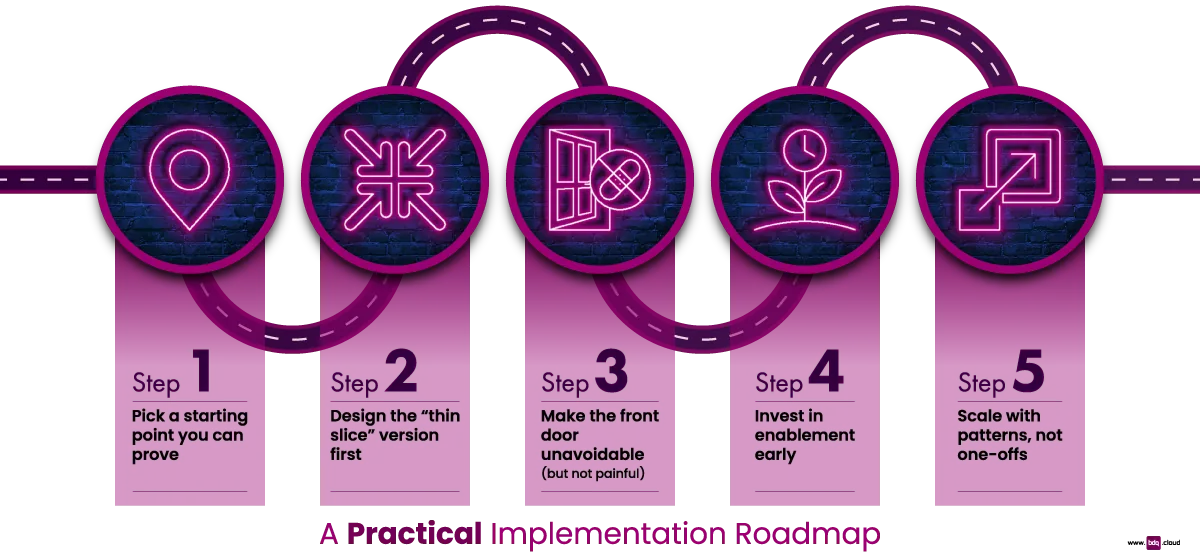
Five steps to a working ESM rollout
- Pick a starting point you can prove. Choose a function with meaningful pain (volume, delays, complaints, lack of visibility), a willing service owner, and measurable outcomes such as cycle time, satisfaction or backlog size. HR onboarding, Facilities requests and Legal contract review are common starters.
- Design the thin-slice version first. Your first release should be the smallest version that beats email: a simple catalogue for the top request types, intake forms that capture the right information, a workflow that routes and tracks status, basic service targets and reporting, and a feedback mechanism. The goal is adoption and proof, not perfection.
- Make the front door unavoidable, but not painful. If the portal is optional and email is still faster, people keep emailing. Often the right approach is to accept email initially while converting it into trackable cases behind the scenes, nudging users towards the portal for faster handling. Consistency changes behaviour.
- Invest in enablement early. Service teams need to understand the new model, requesters need to know where to go and what to expect, and leaders need to know how to read the metrics and act on them. Skipped enablement makes ESM "that system people avoid".
- Scale with patterns, not one-offs. Once the pilot proves value, build repeatable patterns: a standard way to define services, a template for intake forms, a default workflow model, a common reporting pack, and a lightweight governance routine. Scaling then becomes "apply the pattern, adapt where needed".
A realistic 90-day outcome is not "enterprise ESM". It is one service area live and used, clear improvements in visibility and cycle time, a repeatable pattern ready for the next department, and leadership confidence that the approach works. Achieve that and the programme has momentum.
Common pitfalls and how to avoid them
Building a portal before fixing the service
If the process behind the portal is still unclear, the portal just becomes a smarter way to submit requests into the same chaos. Design workflow, ownership and service targets alongside the portal — the front door and the service engine must evolve together.
Copying ITIL language into HR, Finance or Legal
If people feel ESM is "IT making us do ITSM", they will resist it even when the idea is good. Translate the concepts into each function's language. The principles stay consistent; the packaging changes.
Trying to model every exception up front
Over-automation is a real risk. Start with the common paths, handle exceptions with human judgement, and automate selectively once patterns emerge.
Underestimating knowledge management
A portal without knowledge is just a nicer email form. Treat knowledge as part of service design: what do people need to know, what can be self-served, and what guidance reduces rework?
Weak ownership and unclear governance
If nobody owns the services, nobody improves them, and unclear governance produces fragmentation. Set explicit service ownership and a federated governance rhythm that is lightweight but real.
Ignoring privacy and data boundaries
If HR and Legal do not trust the access controls, they will opt out. Design privacy and security up front and prove it early to build confidence.
How to measure ESM success
Measurement is where ESM stops being "a workflow system" and becomes a management capability. Start with a baseline — if you do not know today's reality, you cannot credibly prove improvement. A strong approach measures across several categories: adoption (are people using the intended channels?), experience (is it easier for employees?), flow and speed (where does work get stuck?), quality (reopen rates, first-contact resolution, rework), service performance (are we meeting credible targets?), and business impact (time saved, fewer escalations, improved compliance, faster onboarding).
| Category | What you are trying to learn | Examples of useful measures |
|---|
| Adoption | Are people using the intended channels? | Portal usage vs email, repeat usage, self-service rate |
| Experience | Is it easier for employees? | Satisfaction, effort score, feedback themes |
| Flow and speed | Where does work get stuck? | End-to-end cycle time, time waiting vs time working |
| Quality | Are we resolving properly? | Reopen rates, first-contact resolution, rework volume |
| Service performance | Are we meeting targets credibly? | Service target achievement by request type |
| Business impact | What changed for the organisation? | Time saved, fewer escalations, improved compliance, faster onboarding |
The crucial point: ESM measurement is not about hitting SLA numbers for their own sake. It is about creating a feedback loop that lets departments improve their services intentionally. If you can turn service delivery into something you can see and manage, you have already changed the organisation.
The path forward
ESM looks obvious in hindsight. Most organisations already provide internal services and already feel the pain of fragmented intake, poor visibility and unpredictable turnaround. ESM simply gives a disciplined way to manage and improve what is already happening. For IT directors there is a genuine leadership opportunity here — not because ESM is "an IT project", but because IT tends to have the most mature playbook for service thinking, workflow, reporting and adoption at scale.
The organisations that do ESM well tend to share a few traits: they focus on the employee experience, not just process compliance; they start small, prove value, and scale with patterns; they build a federated operating model that respects departmental ownership; they take privacy and data boundaries seriously; and they invest in enablement and adoption, not just configuration. Take that approach and ESM becomes a practical way to make internal service delivery faster, more transparent, and easier to improve — without turning the business into a bureaucracy.
Conclusion: what to take away from this ESM guide
Enterprise Service Management is more than "ITSM for the rest of the business". It is a scalable operating model that transforms how internal services are delivered, tracked, and improved. The key takeaways from this guide:
- ESM standardises internal service delivery across departments like HR, Facilities, Legal and Finance without turning them into "mini-IT teams".
- A single service front door creates structured intake, improves triage, and makes demand visible — leading to faster resolution and less back-and-forth.
- Workflows, approvals and SLAs need to reflect the unique needs and language of each function, especially for sensitive areas like HR or Legal.
- Federated governance works best: let departments own their services, while a central team maintains standards and shared reporting.
- Start small, scale smart: success comes from launching a focused pilot, proving value quickly, and expanding with repeatable patterns.
- Real visibility means measurable improvement: cycle time, rework, adoption rates and satisfaction can all be tracked — and improved.
Next steps for IT directors
If you are already running ITSM, you are in a strong position to lead an ESM initiative. The principles are familiar, but the scope is wider and the success factors are more nuanced. Here is how to move forward.
- Identify a high-impact pilot area. HR onboarding, Facilities requests, or Legal contract reviews are great starting points with visible pain and measurable value.
- Build a thin slice first. Focus on delivering a better experience than email: clear intake, routed workflow, and basic reporting.
- Establish service ownership and governance early. Do not wait to define who owns each service, and how standards will be maintained across functions.
- Translate, do not impose, ITSM language. Ensure other departments see the value of ESM in their terms, not just IT's.
- Make the front door unavoidable but friendly. Gradually move users from email to structured requests through smart transitions, not mandates.
How BDQ can help
If you are exploring ESM, the tricky part is rarely understanding the concept. It is making it land in the reality of your organisation: different functions, different priorities, different data sensitivities, and different levels of process maturity. BDQ helps organisations improve service delivery and work delivery with a pragmatic, adoption-led approach. We are tool-agnostic and focus on outcomes: clearer services, smoother intake, better visibility, and workflows that people will actually use.
In practice, that often looks like this. We start with rapid discovery to identify the services that matter most, the friction points, and what a thin-slice pilot should include. We use prototyping to validate the experience early, so you are not waiting until the end to find out the design does not fit. We then iterate into a working release, support rollout and adoption, and continue improving through a sensible enhancement cycle rather than a never-ending "phase two". Because ESM often connects to work management as well as ITSM, we can also help you shape how the service front door integrates with delivery tools, so requests become visible demand and execution becomes manageable work.
If you want to sanity-check your ESM plan, choose a pilot area, or define an operating model that will not collapse under real usage, BDQ can help you do that in a structured but lightweight way. The Ask-a-Question form below goes straight to a consultant. A good next read is what is ITSM, which covers the foundations ESM builds on.
This article is part of our Knowledge Hub. If you spot an error or have a follow-up, the Ask-a-Question block below goes straight to a consultant.