
Blog · 24 June 2026
Why Tooling Decisions Feel Harder Than They Should
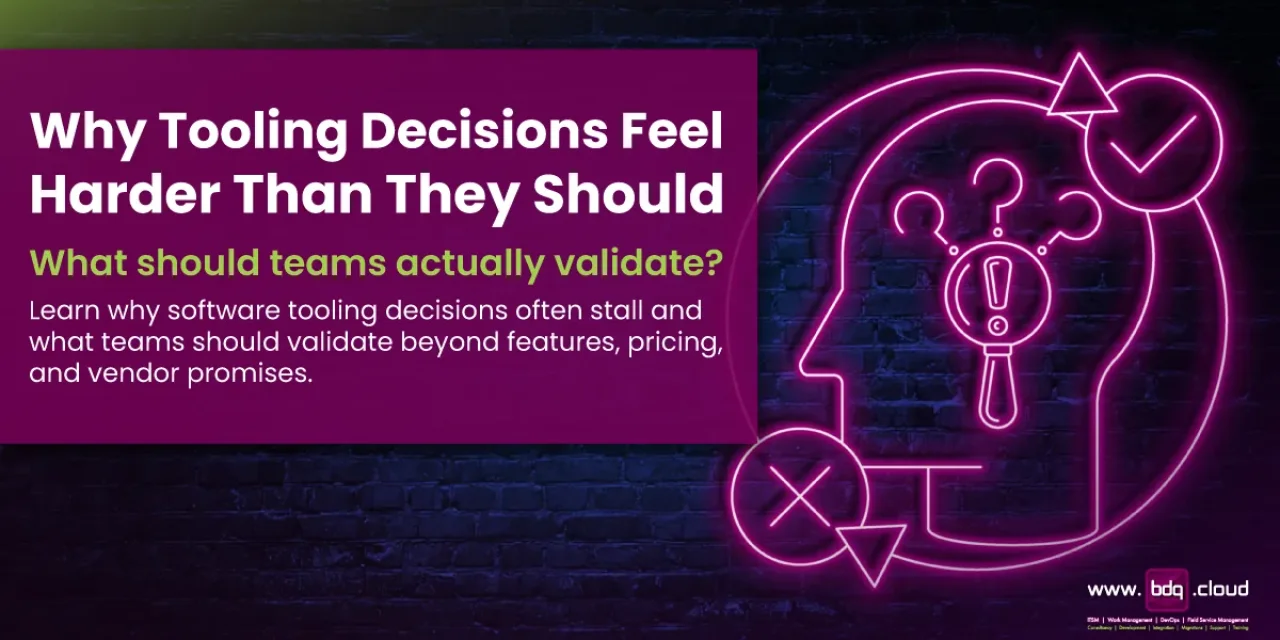
Learn why software tooling decisions often stall and what teams should validate beyond features, pricing, and vendor promises.
BDQ Team
Migration
ITSM
Automation
Customer stories across migration, ITSM, work management and automation.
All success stories →Blog · 24 June 2026
Learn why software tooling decisions often stall and what teams should validate beyond features, pricing, and vendor promises.
BDQ Team
When organisations start evaluating new tools, the conversation often begins with functionality.
Can it automate workflows? Support reporting? Integrate with existing systems? Scale across teams?
Those questions matter, but they're rarely what slows a decision down.
The real challenge isn't the feature list
Instead, the hesitation often comes from everything surrounding the product:
The bigger the organisation, the more important these questions become.
Choosing a platform isn't usually difficult because of the features. It's the uncertainty around scalability, long-term costs, and hidden trade-offs that creates hesitation. Understanding what to validate beyond the sales pitch can help teams make more confident tooling decisions.
Technology buyers have learned from experience.
Many organisations have invested in platforms that looked perfect during evaluation, only to discover unexpected costs, licensing complexities, or operational challenges later.
Over time, this creates a natural scepticism.
When a solution appears straightforward, affordable, or unusually flexible, the response is often:
"What's the catch?"
That's not necessarily a negative reaction. It's usually the result of teams trying to avoid repeating past mistakes.
One of the most common mistakes in software evaluation is focusing too heavily on licence costs.
Price matters, but it's only one part of the equation.
The broader picture often includes:
A platform with a lower licence fee isn't always the least expensive option over time.
Likewise, a higher upfront investment can sometimes deliver greater value if it reduces operational overhead and improves adoption.
Rather than comparing feature checklists alone, it's worth evaluating a few key areas.
Can the platform grow with the business?
Consider how pricing, governance, reporting, and administration will evolve as the organisation expands.
Even the most capable solution will struggle if people don't use it.
Look at the user experience, training requirements, and how easily different teams can incorporate the platform into their daily work.
Think beyond year-one costs.
What will the platform cost to operate, support, and maintain over the next three to five years?
How clearly does the vendor explain pricing, limitations, support models, and future roadmap plans?
Trust often comes from transparency rather than promises.
Ultimately, tooling decisions aren't really about software.
They're about outcomes.
Better collaboration. Improved visibility. Faster delivery. Lower operational costs. Better customer experiences.
The platform is simply the mechanism that helps achieve those goals.
That's why successful evaluations tend to focus less on individual features and more on whether a solution supports the outcomes the organisation is trying to achieve.
Before making a decision, consider asking:
The answers to these questions often reveal more than any feature comparison spreadsheet ever could.
If you're currently evaluating platforms, reviewing costs, or questioning whether a solution will scale with your organisation, you're not alone.
The goal isn't to find the "perfect" tool. It's to find the right tool for your organisation's needs, both today and tomorrow.
At BDQ, we regularly help organisations navigate these conversations and focus on the factors that drive long-term success rather than short-term comparisons.
You can learn more about our approach to consultancy and digital transformation on our "About Us" page.
Book a 30-min consult
Tell us roughly what you’re facing. We’ll come back within one business day with thoughts, references, and a sense of whether we’re a good fit.
Keep reading
Explore common ITSM and work management challenges through WorkFlowFest, a fun festival-inspired take on modern operatio
Read article →Discover what's new in GLPI Carbon 1.3.0, including total emissions, decommission tracking, and usability improvements f
Read article →Discover why organisations are choosing HaloITSM for long-term service management, and how BDQ helped CHC Helicopter mig
Read article →We use cookies to keep the site working and to power features like our live chat. Analytics are cookieless. See our privacy policy.