
Blog · 8 September 2026
AI is Changing IT Service Management KPIs
Discover how AI is reshaping ITSM KPIs and why IT leaders must measure both service performance and AI effectiveness for better outcomes.
Migration
ITSM
Automation
Customer stories across migration, ITSM, work management and automation.
All success stories →Blog · 8 September 2026
Discover how AI is reshaping ITSM KPIs and why IT leaders must measure both service performance and AI effectiveness for better outcomes.
For years, IT Service Delivery Managers have relied on familiar metrics to understand the health of their service desk.
❓ How many incidents were raised?
❓ What was the Mean Time to Resolve (MTTR)?
❓ How many SLA breaches occurred?
❓ How satisfied were customers?
These measures remain essential. However, as AI becomes embedded within modern ITSM platforms, they are no longer sufficient on their own.
Today, Service Delivery Managers increasingly need to understand not only how well their service desk performs, but also how well AI performs within that service desk.
That represents one of the biggest changes to ITSM reporting in years.
Artificial Intelligence isn't replacing traditional IT Service Management (ITSM) metrics - it's adding a new layer of accountability. Service Delivery Managers now need to measure not only the performance of their service desk, but also the quality, accuracy and effectiveness of the AI supporting it. Organisations with mature processes, trusted data and good governance will be best placed to realise the benefits of AI.
Good service management has always been built around measurable outcomes.
Typical KPIs include:
Incident volume
Mean Time to Resolve (MTTR)
First Contact Resolution
SLA compliance
Ticket backlog
Customer Satisfaction (CSAT)
Change success rate
These metrics help organisations understand whether processes are efficient and whether customers are receiving the expected level of service.
Platforms such as Jira Service Management and HaloITSM already provide powerful reporting capabilities for these traditional KPIs. The challenge now is understanding how AI influences them.
 Traditional ITSM metrics still matter
Good service management has always been built around measurable outcomes.
Typical KPIs include:
Incident volume
Mean Time to Resolve (MTTR)
First Contact Resolution
SLA compliance
Ticket backlog
Customer Satisfaction (CSAT)
Change success rate
These metrics help organisations understand whether processes are efficient and whether customers are receiving the expected level of service.
Platforms such as Jira Service Management and HaloITSM already provide powerful reporting capabilities for these traditional KPIs. The challenge now is understanding how AI influences them.
When AI is used to classify incidents, recommend resolutions, summarise tickets or automate repetitive work, it effectively becomes another component of your service delivery process.
That means it should be measured just like any other process.
Instead of simply asking:
Did our Incident Management process perform well?
IT leaders are increasingly asking:
Did our AI help the process perform better?
This subtle shift has significant implications for governance and reporting.
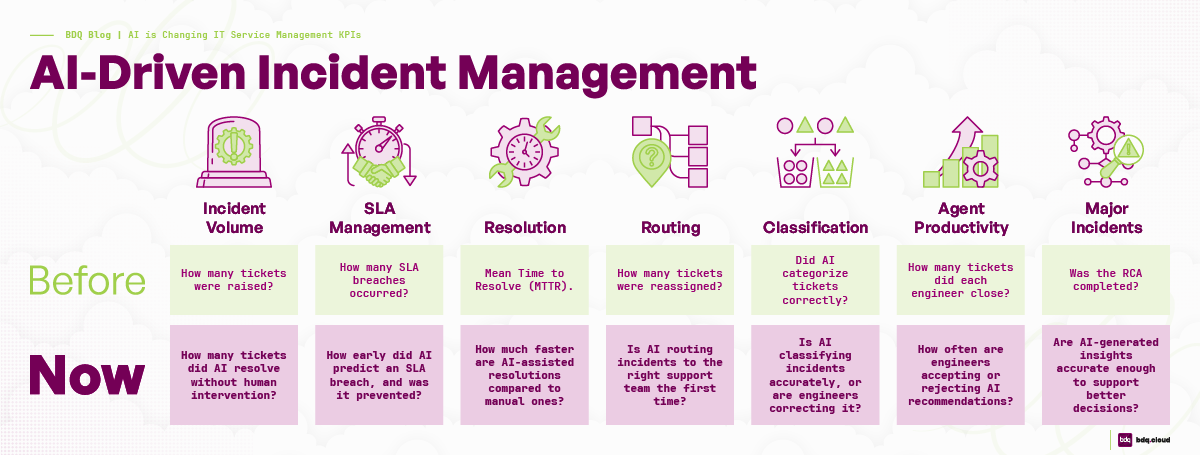
Traditional service desk metrics don't disappear - they evolve.
Traditional KPI | AI-enabled KPI |
|---|---|
Incident volume | Percentage of incidents resolved by AI without human intervention |
MTTR | Improvement in AI-assisted resolution times |
SLA breaches | AI prediction accuracy and prevented breaches |
Ticket routing | AI first-time routing accuracy |
Incident categorisation | AI classification accuracy and correction rate |
Agent productivity | Acceptance rate of AI recommendations |
Knowledge usage | Effectiveness of AI-generated answers |
Major incident reviews | Accuracy of AI-generated insights and summaries |
Rather than replacing existing dashboards, these measures complement them.
Together they provide a much clearer picture of operational performance.
One of the biggest misconceptions surrounding AI is that implementing it automatically improves service management.
In reality, AI is heavily dependent on the quality of the environment in which it operates.
If your service desk suffers from:
inconsistent categorisation
poor knowledge management
fragmented processes
incomplete asset data
weak automation
inaccurate configuration information
… then AI is likely to amplify those weaknesses rather than solve them.
Successful AI adoption starts with mature service management practices, trusted enterprise data and well-defined processes.
This is one reason why many organisations choose to optimise their ITSM platform before introducing advanced AI capabilities.
As AI becomes more capable, governance becomes increasingly important.
Service Delivery Managers are no longer responsible solely for ensuring incidents are resolved quickly and efficiently.
They are also increasingly responsible for understanding:
whether AI recommendations are accurate
where human intervention is still required
whether AI is delivering value
whether AI decisions remain consistent with business policies
whether reporting demonstrates measurable improvements
AI should not become a "black box" within IT operations.
Like any other business capability, it requires monitoring, continual improvement and governance.
 Reporting becomes even more valuable
We've written previously about the importance of management reporting within Jira, and how dashboards, KPIs and visual reporting help organisations understand what is really happening across their teams.
As AI becomes embedded into service management, reporting becomes even more valuable.
Rather than simply showing operational performance, dashboards will increasingly demonstrate:
AI adoption
automation effectiveness
knowledge quality
service improvements
operational efficiency gains
The organisations that benefit most from AI will be those that can measure its impact objectively.
Artificial Intelligence represents a significant opportunity for IT teams.
However, AI should be viewed as an intelligence layer built on top of existing ITSM practices, rather than a replacement for them.
The strongest results come from organisations that already have:
mature Incident, Problem and Change Management
reliable service data
well-designed workflows
effective automation
meaningful reporting
strong governance
These foundations allow AI to deliver faster resolutions, improved customer experiences and better operational insight.
At BDQ, we help organisations implement and optimise Jira Service Management, HaloITSM and related service management solutions, with a focus on improving reporting, automation and long-term adoption. Our Agile, prototype-led approach ensures that processes, dashboards and governance are designed around business outcomes rather than technology alone.
“BDQ were really hands-on. Their consultant was brilliant, and really knew his stuff.”
→ The Wine Society | BDQ JSM Migration Customer
Whether you're modernising an existing service desk or preparing your organisation for AI-enabled ITSM, building the right foundation is the first step.
Ready to improve your ITSM reporting and prepare for AI?
👉 Contact BDQ to discuss your service management goals, or explore our Jira Service Management Consulting and HaloITSM Consulting services to see how we can help.
Book a 30-min consult
Tell us roughly what you’re facing. We’ll come back within one business day with thoughts, references, and a sense of whether we’re a good fit.
More reading
Boost ITSM with AI! Learn how automation & AI-driven insights enhance efficiency, predict issues, and optimize workflows. Discover BDQ’s…
Read story → Help Desk Migration,Help desk vendor lock-in can make switching feel risky. Learn what creates lock-in and how to plan a smoother ITSM migration.
Read story →Discover how sustainable ITSM reduces waste, supports ESG goals, and powers greener, smarter IT service delivery for the future of work
Read story →We use cookies to keep the site working and to power features like our live chat. Analytics are cookieless. See our privacy policy.