

Blog · 24 August 2026
Why Your Context Makes or Breaks AI Agents
Learn why context is essential for AI agents, how it improves accuracy and efficiency, and why context beats bigger prompts every time.
Migration
ITSM
Automation
Customer stories across migration, ITSM, work management and automation.
All success stories →Blog · 24 August 2026
Learn why context is essential for AI agents, how it improves accuracy and efficiency, and why context beats bigger prompts every time.
Artificial intelligence has reached the point where almost everyone is talking about agents.
Some promise autonomous workflows. Others claim they'll replace repetitive tasks or orchestrate complex business processes. But underneath all the excitement is a much simpler question:
Does the agent actually understand the situation it's working in?
If the answer is no, the results are often disappointing. An agent running without context is just a token disposal service.
It's a deliberately provocative statement, but it highlights one of the biggest differences between impressive demos and genuinely useful AI systems.
AI agents aren't useful because they can call tools - they're useful because they understand the context they're operating in. Without that context, even the most capable model wastes tokens, makes poor decisions, and creates more work than it saves.
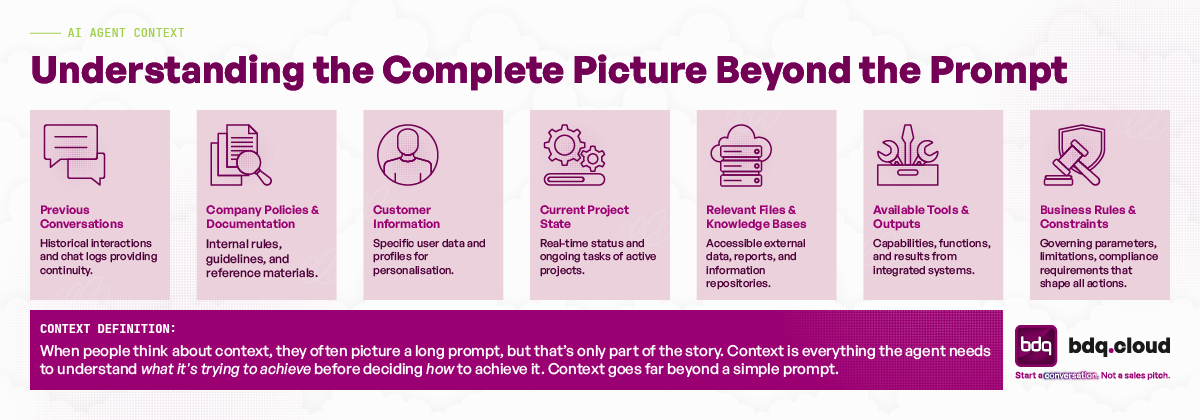
When people think about context, they often picture a long prompt. That's only part of the story.
For an AI agent, context can include:
Previous conversations
Company policies and documentation
Customer information
Current project state
Relevant files and knowledge bases
Available tools and their outputs
Business rules and constraints
In other words, context is everything the agent needs to understand what it's trying to achieve before deciding how to achieve it.
Modern language models can process enormous context windows, but simply filling those windows isn't the same as providing useful context.
If an agent receives hundreds of pages of documentation without knowing which sections matter, it has to spend time and tokens searching, interpreting, and sometimes guessing.
That leads to problems like:
Hallucinated answers
Inconsistent decisions
Unnecessary tool calls
Slower responses
Higher inference costs
The issue isn't that the model lacks intelligence.
It's that you've asked it to work without enough relevant information - or with too much irrelevant information.
One common mistake is treating context as something that's written once and reused forever.
In reality, good context changes constantly.
A customer support agent needs different information from a software deployment agent. A finance workflow needs different permissions from a marketing workflow.
The best agent systems retrieve the right information at the right time rather than stuffing everything into every prompt.
Techniques like Retrieval-Augmented Generation (RAG), structured memory, tool outputs, and workflow state all help provide focused, relevant context when it's needed.
If you're unfamiliar with RAG, OpenAI's guide provides a helpful introduction:
→ OpenAI's Guide to Retrieval-Augmented Generation (RAG)
Ironically, spending more effort on context often means spending fewer tokens overall.
Instead of repeatedly asking an agent to reason from scratch, you provide:
The relevant facts
The current objective
The available actions
The constraints
The agent spends less time exploring dead ends and more time solving the actual problem.
Better context generally leads to:
Faster responses
Lower token usage
More reliable outputs
Fewer retries
Greater user trust
People are far more willing to trust an AI system when they can understand why it reached a decision.
That's much easier when the agent is working from clearly defined sources instead of generating answers from general knowledge alone.
Linking responses back to documentation, policies, or source material creates a feedback loop that's easier to verify and improve.
For guidance on building reliable AI applications, OpenAI's documentation is a useful reference:
→ OpenAI API Platform Documentation
Many organisations begin by asking:
"What tasks should our agent automate?"
A better first question is:
"What information does the agent need before making a decision?"
Once you answer that, the automation often becomes much simpler.
Instead of creating increasingly complicated prompts, you build systems that retrieve the right information, maintain state, and provide meaningful context throughout the workflow.
The result isn't just a smarter agent.
It's a more dependable one.
AI agents are becoming increasingly capable, but capability alone doesn't create value.
The difference between an agent that saves hours of work and one that generates confusion often comes down to the quality of the context it's receives.
So the next time an agent produces an unexpected answer, don't start by asking whether the model is good enough.
Ask whether you've given it enough relevant information to succeed.
Because, after all:
An agent running without context is just a token disposal service.
Book a 30-min consult
Tell us roughly what you’re facing. We’ll come back within one business day with thoughts, references, and a sense of whether we’re a good fit.
Keep reading
Cherwell end of life is 31 December 2026. Learn what happens next, compare Cherwell alternatives and plan a fast, low-ri
Read article →Atlassian is rolling out usage-based pricing for AI and automation from December 2026. Here's what's changing, what it c
Read article →Help desk vendor lock-in can make switching feel risky. Learn what creates lock-in and how to plan a smoother ITSM migra
Read article →We use cookies to keep the site working and to power features like our live chat. Analytics are cookieless. See our privacy policy.